This guide contains affiliate links. We may earn a commission at no extra cost to you — see our Affiliate Disclosure and Affiliate Disclosure Policy for details.
Hokkaido’s capital city is home to some of the most rewarding Sapporo tourist places in all of Japan, offering everything from snow-sculpture-filled parks in winter to lilac-scented gardens in spring. It isn’t just a stopover before Niseko’s ski slopes or a detour on the way to Hakodate — it’s a full destination in its own right, with a walkable center, some of the best food in the country, and a festival calendar that changes the entire personality of the city every few months.
This guide walks through everything you need to plan a trip: the best season to visit, the festivals worth building a trip around, the food you shouldn’t leave without trying, how many days you actually need, where to stay, a day-by-day schedule, and what a realistic budget looks like whether you’re traveling solo or bringing the whole family. If you’re still deciding on flights and connections, our team at Ryde Travel can also help you build out the rest of your Japan itinerary around this Sapporo leg.
To book your stay, click here. To Book Local Travel, click here
Traveling overseas? Click here to buy an eSIM. For more info, click here
Table of Contents
Why Sapporo Deserves a Spot on Your Japan Itinerary
Sapporo is Japan’s fifth-largest city, but it doesn’t feel like it. The streets are laid out on a grid, the subway is simple to navigate, and most of the major sights sit within a compact core you can walk between. It’s also the gateway to the rest of Hokkaido — Otaru’s canal town, Niseko’s powder snow, and Lake Toya’s hot springs are all within a couple of hours.
What makes Sapporo different from Tokyo or Osaka is pace. It’s a city built around seasons. Locals plan their year around the snow festival in February, the lilacs in May, the beer gardens in summer, and the illuminations in December. Visiting with that rhythm in mind — rather than just checking off Sapporo tourist places on a list — makes for a much better trip.
For a lot of travelers, Sapporo also ends up being a surprise favorite compared to the bigger, better-known cities on a standard Japan route. It’s quieter than Tokyo, less crowded than Kyoto during peak season, and the food scene punches well above what you’d expect from a city its size. Because Hokkaido has its own distinct farming and fishing industries, the produce, dairy, and seafood you eat in Sapporo genuinely tastes different from what you’d get further south — locals will tell you this proudly, and after one bowl of miso ramen or a plate of fresh uni, you’ll understand why.
Sapporo is also a practical base. Public transit is reliable, English signage is common around the station and major attractions, and the compact downtown core means you rarely need taxis. Add in a well-organized subway map, a manageable airport transfer, and a city that rewards walking, and it’s easy to see why Sapporo tourist places consistently rank among the top experiences in Hokkaido travel guides and forums.
Best Time to Visit Sapporo Tourist Places
There isn’t a single “best” month for Sapporo — it depends entirely on what kind of trip you want. Here’s how the four seasons break down.
Winter (December to February) — Best for Snow and Festivals
This is peak season, and for good reason. Sapporo turns into a winter wonderland, and the Sapporo Snow Festival is the single biggest reason people fly in from around the world. Expect average temperatures between -7°C and 0°C, heavy snowfall, and short daylight hours (sunset around 4:30 PM). Pack proper winter layers — this is genuinely cold, closer to Chicago or Scandinavia in February than anything most first-time visitors expect.
Spring (April to May) — Best for Mild Weather and Lilacs
Spring is the sweet spot for travelers who want fewer crowds and comfortable walking weather. Cherry blossoms bloom later here than in Tokyo or Kyoto, usually late April to early May, and the city’s famous lilac trees bloom in mid-May, coinciding with the Sapporo Lilac Festival in Odori Park.
Summer (June to August) — Best for Festivals and Food
Hokkaido summers are famously mild compared to the rest of Japan — while Osaka and Tokyo swelter in humidity, Sapporo rarely climbs past 26°C. This is when the city’s beer gardens open in Odori Park, and it’s arguably the best season for fresh seafood, corn, and melon from Hokkaido’s farms.
Autumn (September to November) — Best for Fall Colors and Quiet Sightseeing
Autumn brings crisp air, fewer tourists, and some of the best foliage in Japan around Jozankei Onsen and Mt. Moiwa, usually peaking in mid-to-late October. It’s an underrated time to hit the major Sapporo tourist places without the winter crowds or summer heat.
Quick recommendation: If your priority is the snow festival, go early February. If you want a calmer trip with great weather, aim for May or late September.
A Month-by-Month Snapshot
If you’re weighing options against other parts of your Japan trip, here’s a quick month-by-month read on Sapporo:
- January – Deep winter, cold but fewer crowds than festival week; good for ski access to Niseko or Rusutsu.
- February – Peak season for the Snow Festival; the coldest month, but also the most iconic.
- March – Snow starts melting, a transitional and often overlooked month with lower hotel rates.
- April – Mild spring weather begins, cherry blossoms start appearing toward the end of the month.
- May – Comfortable temperatures, cherry blossoms and lilacs bloom, one of the best all-around months.
- June–August – Mild, dry summer relative to the rest of Japan, beer gardens and festivals in full swing.
- September – Early autumn, harvest festivals, still warm enough for comfortable walking.
- October – Peak foliage season, especially around Mt. Moiwa and Jozankei.
- November – Cooling down fast, first snowfall usually arrives, White Illumination begins late in the month.
- December – Christmas markets and illuminations, colder but festive, good lead-in to the winter season.
Sapporo Festivals Worth Planning Your Trip Around
Sapporo’s festival calendar is one of the city’s biggest draws, and timing your visit around one can transform an ordinary trip into a genuinely memorable one.
Sapporo Snow Festival (Late January – Early February)
The Sapporo Snow Festival is one of Japan’s most famous winter events, held every February across three venues in the city. It was started in 1950, when high school students built a few snow statues in Odori Park, and has since developed into a large event featuring spectacular snow and ice sculptures that attract huge numbers of visitors, staged across the Odori Site, Susukino Site, and Tsu Dome Site. The festival draws over two million visitors in a single week and features giant snow sculptures the size of buildings.
The upcoming edition runs from Thursday, February 4 to Thursday, February 11, 2027, marking the 77th edition of the festival. Entry to all three venues is completely free, and there are plenty of food stands offering a huge variety of dishes to try while you walk through.
A practical note if you’re planning around it: hotel availability during festival week is the tightest of the entire year, so booking three to six months ahead is strongly recommended, and the festival’s closing date falls on National Foundation Day, a public holiday that pushes prices even higher.
Nearby winter events worth combining with your trip include the Otaru Snow Light Path Festival, a shorter train ride away, known for its snow lanterns and candlelit canal streets, and the Asahikawa Winter Festival, famous for a record-breaking giant snow sculpture along with fireworks and live performances.
Sapporo Lilac Festival (Mid-May)
Held in Odori Park, this festival celebrates the blooming of over 400 lilac trees with food stalls, live music, and a relaxed, garden-party feel — a strong contrast to the intensity of the snow festival.
Sapporo Summer Festival (Late July – Mid August)
This is when Odori Park fills with beer gardens run by major Japanese breweries, alongside the Susukino Festival and a large fireworks display. It’s a great time to sample Hokkaido’s food scene outdoors.
Sapporo Autumn Fest (September)
A food-focused festival in Odori Park showcasing Hokkaido’s harvest — seafood, dairy, corn, potatoes, and local sake and wine from stalls representing different regions of the prefecture.
Sapporo White Illumination (Late November – Late December)
Odori Park and the streets around Sapporo Station are strung with lights for the holiday season, and it overlaps with the Munich Christmas Market Sapporo, a charming European-style market with mulled wine and handicrafts.
Best Sapporo Tourist Places to Visit
Here are the Sapporo tourist places that consistently make it onto every well-planned itinerary, grouped roughly by area so you can see how they fit together geographically.
1. Odori Park
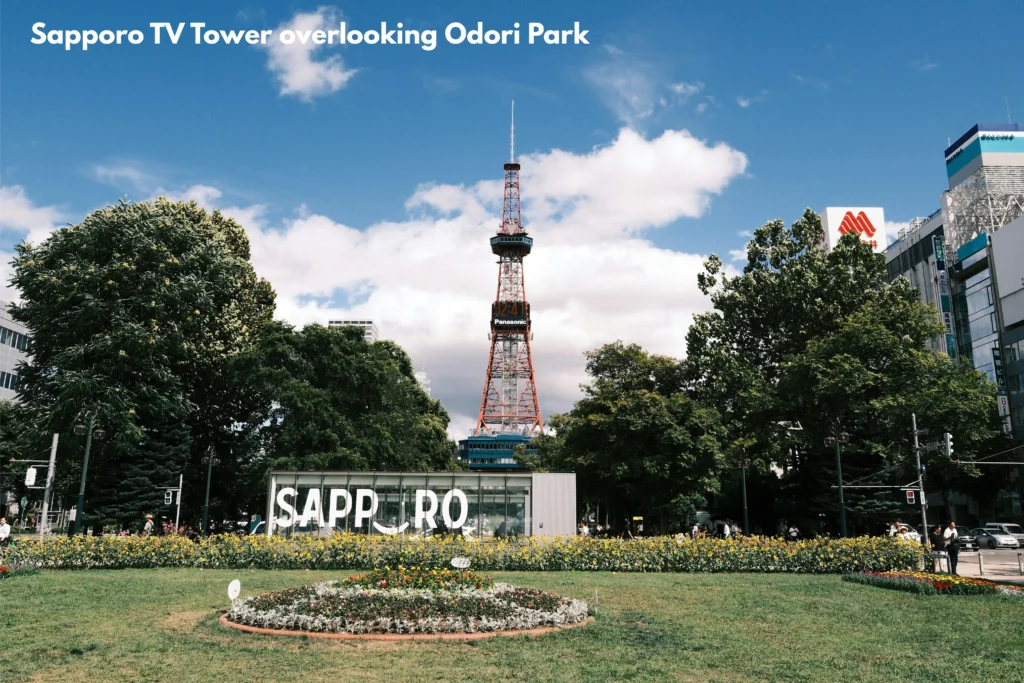
The green spine of the city, running 1.5 km through downtown from the TV Tower to Nishi 11-chome. It hosts nearly every major festival — the Snow Festival, Lilac Festival, Summer Festival, and White Illumination all take place here — and it’s the best orientation point for first-time visitors, since most other Sapporo tourist places sit within a 20-minute walk of it. In quieter months it’s simply a pleasant place to sit with a coffee and watch the city go by.
2. Sapporo TV Tower
Sitting at the eastern end of Odori Park, the 147.2-meter tower’s observation deck gives a good overview of the park and the surrounding city grid. It’s best visited at dusk, when you can watch the skyline shift from daylight into the city’s evening lights, and it pairs naturally with a walk down the length of Odori Park afterward.
3. Sapporo Clock Tower
One of the most recognizable Sapporo tourist places, this wooden clock tower dates back to 1878 and once served as a drill hall for the Sapporo Agricultural College. It’s smaller than most visitors expect, but it remains a genuinely important symbol of the city’s founding, and the small museum inside covers Sapporo’s early history for those who want more context.
4. Former Hokkaido Government Office Building (Akarenga)
A red-brick, Neo-Baroque building completed in 1888, this is one of the most photographed landmarks in Sapporo, especially in autumn when the surrounding trees turn and reflect in the pond out front. The interior houses historical exhibits on Hokkaido’s development, and admission is free, making it an easy add-on to a Clock Tower visit.
5. Hokkaido Jingu (Hokkaido Shrine)
Set inside Maruyama Park on the western edge of downtown, this Shinto shrine was established to watch over Hokkaido’s development and is especially beautiful during cherry blossom season, when the approach path fills with blooming trees. It offers a quieter, forested contrast to the city center and is a good stop to combine with Maruyama Zoo or Maruyama Park itself.
6. Mt. Moiwa
A short cable car ride followed by a mini-funicular takes you to a 531-meter summit with panoramic night views over Sapporo, regularly ranked among Japan’s top three night views alongside Nagasaki and Kobe. Go around 30 minutes before sunset to catch the transition from daylight to the city’s lights coming on — it’s one of the most consistently recommended Sapporo tourist places for couples and photographers alike.
7. Susukino
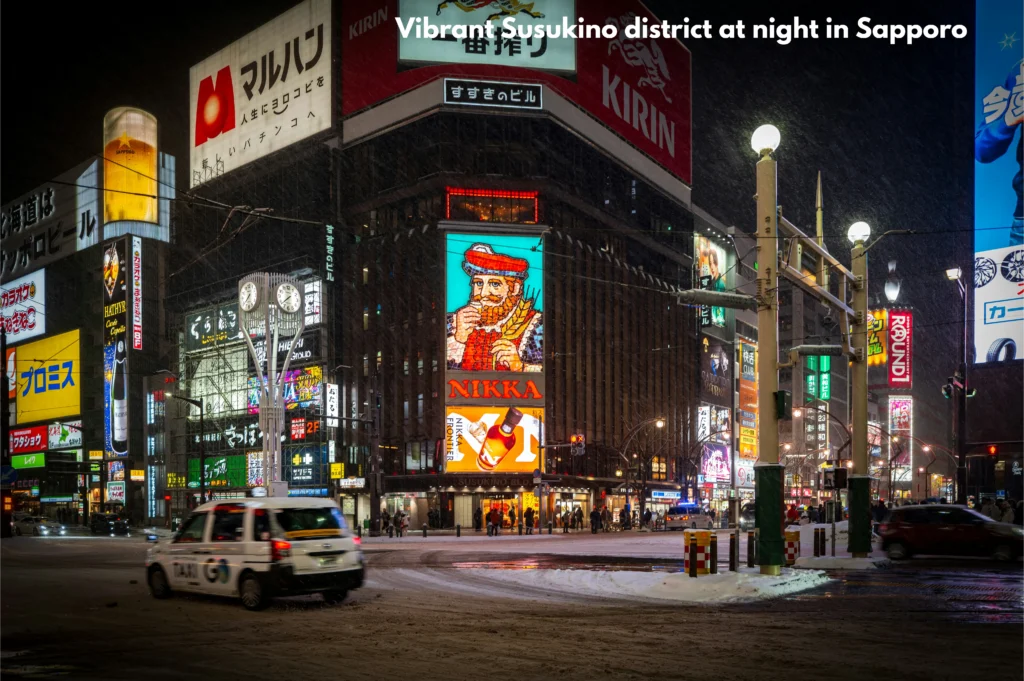
Sapporo’s entertainment and dining district, packed with ramen shops, izakayas, karaoke bars, and neon signage that lights up the whole neighborhood after dark. It’s also one of the three official Sapporo Snow Festival venues, home to elaborate ice sculptures during festival week. Even outside festival season, it’s the best area to wander for dinner and a casual night out.
8. Nijo Market
A compact seafood market just a few minutes from Odori, great for fresh sashimi bowls, king crab, sea urchin, and Hokkaido melon. It’s smaller and more manageable than Tokyo’s Tsukiji or Toyosu markets, making it a good stop for lunch between sightseeing rather than a half-day commitment.
9. Sapporo Beer Museum and Garden
Housed in a red-brick former brewery building, this museum covers the history of Japanese beer from the Meiji era onward, with well-preserved industrial equipment on display. A beer hall attached to the museum lets you sample seasonal brews alongside Genghis Khan barbecue, making it an easy pairing of sightseeing and dinner in one stop.
10. Shiroi Koibito Park
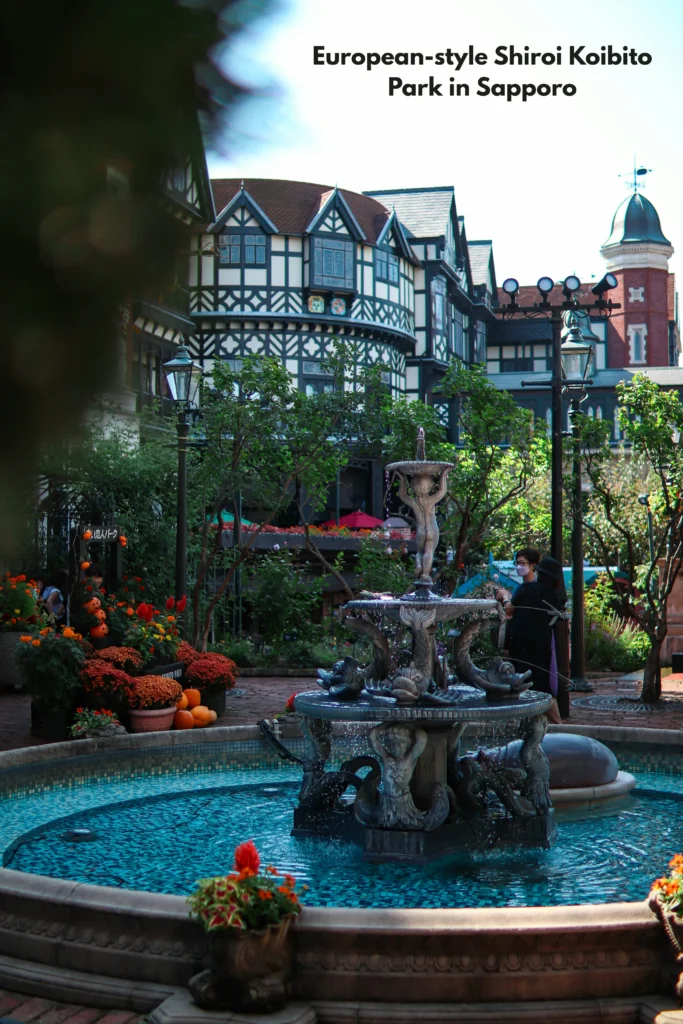
A chocolate-themed factory park named after Hokkaido’s famous “Shiroi Koibito” cookie, built around a European-style building with chocolate-making demonstrations, a rose garden, and a small train that runs for kids. It’s one of the more family-friendly Sapporo tourist places, with hands-on cookie-decorating workshops available for an extra fee.
11. Historical Village of Hokkaido
An open-air museum outside the city center with more than 50 relocated Meiji and Taisho-era buildings, including a former train station, farmhouses, and shops, all staffed by guides in period clothing. It takes half a day to explore properly but offers a much deeper look at Hokkaido’s pioneer history than anything downtown.
12. Maruyama Zoo
Book Your Tour package in Sapporo
A family-friendly stop inside Maruyama Park, known for its polar bear enclosure and a strong conservation program covering endangered species from across Japan and abroad. It’s compact enough to see in two to three hours, making it easy to combine with Hokkaido Jingu on the same morning.
13. Sapporo Art Park
A large sculpture-filled park combining an outdoor museum, a botanical garden, and an indoor museum dedicated to sculptor Kotaro Takamura. It sits a little further from the center than most other Sapporo tourist places, which keeps it quieter — a good half-day trip for art lovers who want a break from the busier downtown sights.
14. Otaru (Day Trip)
Not technically in Sapporo, but a 35-minute train ride away, Otaru’s historic canal, glassware workshops, music box shops, and sushi restaurants make it the most popular day trip from the city. The canal is particularly photogenic in the evening when the old gas lamps light up along the water, and it pairs naturally with the Snow Light Path Festival if your dates line up with winter.
15. Tanukikoji Shopping Street
A covered, seven-block shopping arcade running parallel to Susukino, useful on rainy or snowy days when you still want to walk between shops, cafes, and small restaurants without dealing with the weather. It’s less of a headline attraction and more of a practical, weatherproof way to spend a few hours between bigger sights.
Food to Try Around Sapporo Tourist Places
Sapporo is arguably the best food city in Hokkaido, and a trip built around Sapporo tourist places should leave real room in the schedule for eating.
- Miso ramen – Sapporo is credited as the birthplace of miso ramen; Ramen Yokocho in Susukino is the classic alley to try it.
- Soup curry – A Sapporo original: a thin, spiced curry broth served with rice and whole vegetables or chicken.
- Genghis Khan (Jingisukan) – Grilled lamb and vegetables cooked on a domed skillet at the table, often paired with local beer.
- Fresh seafood – Uni (sea urchin), ikura (salmon roe), and crab bowls (kaisendon) at Nijo Market or Sapporo Central Wholesale Market.
- Hokkaido dairy – Soft-serve ice cream, cheese, and milk-based sweets are noticeably richer here thanks to Hokkaido’s dairy farms.
- Sapporo Beer – Try it fresh at the Sapporo Beer Museum’s beer hall, paired with Genghis Khan.
- Shiroi Koibito cookies – A classic Hokkaido souvenir: white chocolate sandwiched between two thin cookies.
- Hokkaido melon and corn – In summer, roadside stalls and department store food halls sell some of the sweetest melon in Japan, along with fresh-grilled corn on the cob.
- Sapporo-style stamina ramen and butter corn ramen – A regional twist that adds a knob of butter and sweet corn to a rich pork or miso broth, said to have originated in Sapporo’s cold winters.
Ramen Yokocho in Susukino remains the most famous alley for miso ramen, but it’s worth branching out to Ramen Republic (inside the Esta building near Sapporo Station) if you want to try multiple regional ramen styles from across Japan in one visit. For soup curry, look for shops that let you choose your spice level — most start mild by Western standards but can go extremely hot on request.
Getting Around Sapporo
Sapporo’s subway system has three lines — Namboku, Tozai, and Toho — plus a streetcar loop and bus network, all of which cover the major Sapporo tourist places without much difficulty. A one-day subway pass is worth it if you’re making more than three trips in a day, and IC cards (Suica, Kitaca) work across trains, subways, and most convenience stores.
The city center is genuinely walkable — Odori Park, the Clock Tower, the Former Government Office Building, and Susukino are all within about a 15-20 minute walk of each other, and Sapporo’s underground walkway network (Chika-ho) connects many of these Sapporo tourist places, which is especially useful in winter when you’d rather not be outside in -5°C wind. For Sapporo tourist places further from downtown — Mt. Moiwa, Maruyama Park, and the Sapporo Beer Museum — you’ll want the subway or a short bus ride. Otaru and the Historical Village of Hokkaido both require a train, and Shiroi Koibito Park is a short subway-plus-walk combination from downtown.
Taxis are reliable but pricier than in most of Southeast Asia — reserve them for late-night trips back from Mt. Moiwa or when carrying heavy luggage rather than for regular sightseeing.
What to Pack for Your Sapporo Tourist Places Trip
Packing changes a lot depending on the season, but a few things hold true year-round: omfortable walking shoes, a reusable water bottle, and a portable phone charger for long days out at Sapporo tourist places.
- Winter (Dec–Feb): Heavy insulated coat, thermal base layers, waterproof boots with good grip (sidewalks get icy), gloves, and a hat — this is genuinely cold weather, not “bring a light jacket” cold.
- Spring (Mar–May): Layers you can adjust through the day, a light rain jacket, and a warmer layer for evenings, which still cool down noticeably.
- Summer (Jun–Aug): Light breathable clothing, sunscreen, and a light layer for evenings — Sapporo summers are mild, but air conditioning indoors can still feel cold by contrast.
- Autumn (Sep–Nov): A mid-weight jacket, layers, and a scarf for late autumn once temperatures start dropping toward winter levels.
How Many Days Do You Need in Sapporo?
For most travelers, 3 to 5 days is the right amount of time to cover the main Sapporo tourist places without rushing.
- 2 days – Enough for the city center only: Odori Park, Clock Tower, Susukino, and Mt. Moiwa.
- 3–4 days – Covers the city center plus a day trip to Otaru or the Historical Village of Hokkaido.
- 5 days – Comfortable pacing with a rest day, plus room for the Sapporo Snow Festival or Lilac Festival if your dates line up, and a second day trip (Jozankei Onsen or Otaru).
If you’re combining Sapporo with the rest of Hokkaido — Niseko, Furano, or Hakodate — plan for at least 7-10 days total, with Sapporo as your 3-4 day anchor point.
Day-by-Day Sapporo Itinerary: Where to Go First
Here’s a step-by-step schedule that groups Sapporo tourist places by location to minimize backtracking, assuming a 5-day trip.
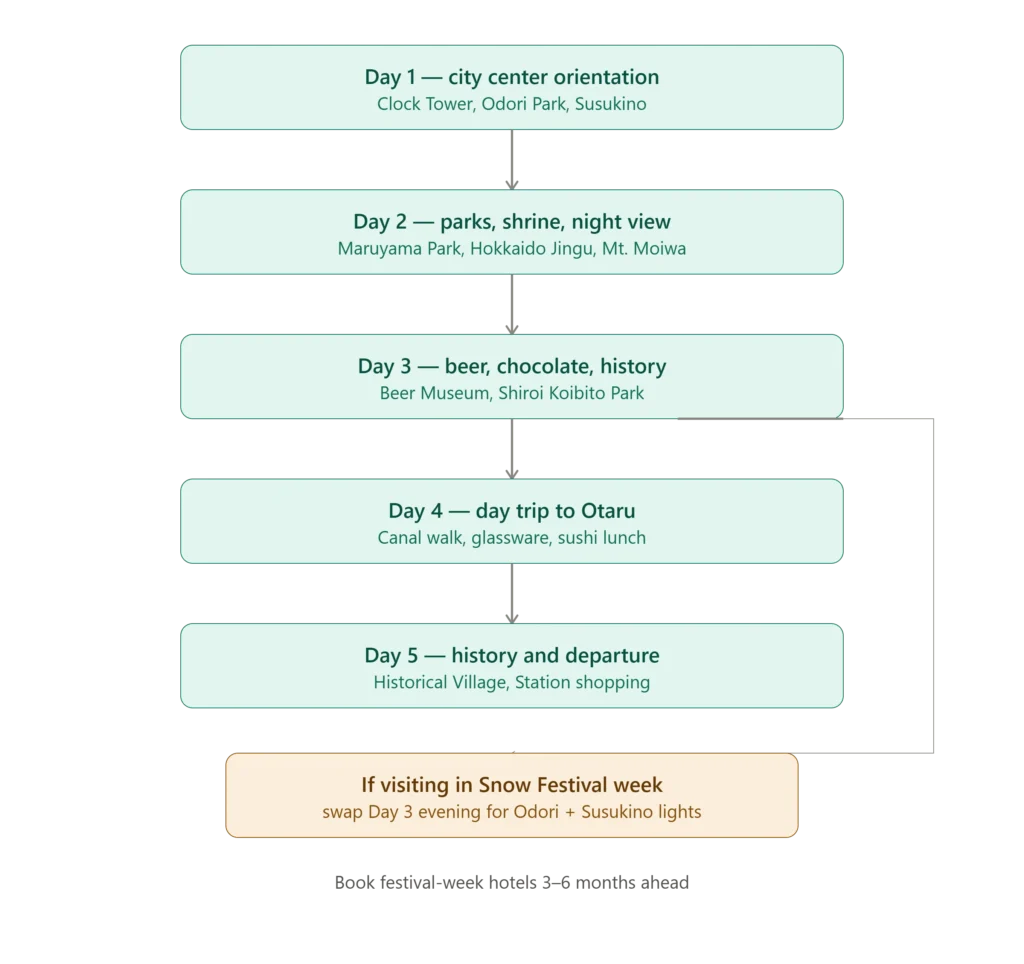
Day 1: City Center Orientation
- Morning: Sapporo Clock Tower → Former Hokkaido Government Office Building
- Midday: Lunch at Nijo Market (seafood bowl)
- Afternoon: Odori Park (walk end to end) → Sapporo TV Tower
- Evening: Dinner and ramen crawl in Susukino
Day 2: Parks, Shrine, and Night View
- Morning: Maruyama Park and Hokkaido Jingu
- Midday: Maruyama Zoo (good for families)
- Afternoon: Sapporo Art Park
- Evening: Mt. Moiwa cable car for sunset and night views
Day 3: Beer, Chocolate, and History
- Morning: Sapporo Beer Museum and Garden
- Midday: Genghis Khan lunch at the beer hall
- Afternoon: Shiroi Koibito Park
- Evening: Free evening in Odori Park (festival browsing if your dates line up) or a quiet night in Susukino
Day 4: Day Trip to Otaru
- Full day: Train to Otaru, walk the canal, browse glassware shops, sushi lunch, return to Sapporo by evening
Day 5: Historical Village and Departure Buffer
- Morning: Historical Village of Hokkaido
- Afternoon: Last-minute shopping near Sapporo Station (Stellar Place, Tanukikoji Shopping Street)
- Evening: Departure or onward travel
If your trip is timed for the Sapporo Snow Festival, swap Day 3’s evening for a full evening at Odori Park, and add a second evening in Susukino to see the ice sculptures lit up after dark — weekday mornings tend to be quieter, with the opening and closing weekends and evenings being the busiest times to visit.
Where to Stay: Hotels Near Sapporo Tourist Places
Three neighborhoods near the main Sapporo tourist places cover almost everyone’s needs:
Sapporo Station Area
Best for convenience — direct access to the airport train (Rapid Airport), shopping, and an easy walk to Odori Park. Good for first-time visitors and families who want fewer transfers with luggage.
Odori / Downtown
Right in the middle of the action, closest to the Snow Festival’s main venue and Odori Park. Slightly higher rates during festival weeks, but unbeatable for walkability.
Susukino
Best for travelers prioritizing nightlife and food, with the highest concentration of restaurants and izakayas within walking distance. It’s also one of the three festival sites.
Budget tip: if you’re visiting during Snow Festival week, book your accommodation three to six months in advance, since it’s the single busiest week of Sapporo’s year and prices rise sharply as dates close in. Outside of festival season, rates drop significantly and same-month booking is usually fine.
Book Your Hotel
Sapporo Tour Expenses: Solo vs. Family Budget
Costs for visiting Sapporo tourist places vary a lot depending on season (festival week is the most expensive period of the year) and travel style. Here’s a rough daily breakdown in USD for a mid-range trip, excluding international flights.
Solo Traveler (per day)
| Category | Budget | Mid-Range |
|---|---|---|
| Accommodation | $35–50 | $70–110 |
| Food | $20–30 | $40–60 |
| Local transport | $8–12 | $8–12 |
| Attractions/activities | $10–20 | $20–35 |
| Daily total | ~$75–110 | ~$140–215 |
A 5-day solo trip lands around $375–1,075, depending on style, before flights.
Family of Four (per day)
| Category | Budget | Mid-Range |
|---|---|---|
| Accommodation (1-2 rooms) | $90–130 | $160–260 |
| Food | $70–100 | $120–170 |
| Local transport | $25–35 | $25–35 |
| Attractions/activities | $40–70 | $70–110 |
| Daily total | ~$225–335 | ~$375–575 |
A 5-day family trip runs roughly $1,125–2,875 before flights, with Snow Festival week pushing toward the higher end due to accommodation demand.
Money-saving tips:
- Use the Sapporo subway one-day pass if you’re moving between more than 3 stops in a day.
- Snow Festival venues, like most free Sapporo tourist places, cost nothing to enter — your main added cost during that week is accommodation.
- Convenience store meals (onigiri, bento) are a legitimate way to cut food costs without sacrificing quality.
- Book Otaru and other day trips using regular JR tickets rather than tour packages if you’re comfortable navigating on your own.
Getting to Sapporo
Most international travelers fly into New Chitose Airport (CTS), about 45 minutes from central Sapporo via the JR Rapid Airport train. If you’re mapping this trip against a wider Hokkaido or Japan route, the team at Ryde Travel can help sort out flight timing, rail passes, and connections so your time at Sapporo tourist places isn’t lost to travel fatigue.
Frequently Asked Questions About Sapporo Tourist Places
How many days do you need to see the best Sapporo tourist places?
Three to five days is enough for most travelers. Two days covers the city center only (Odori Park, Clock Tower, Susukino, Mt. Moiwa), while five days allows for a day trip to Otaru and a slower pace with a rest day built in.
What is the best time of year to visit Sapporo?
It depends on your priorities. Early February is best for the Sapporo Snow Festival, mid-May is ideal for mild weather and lilacs, summer (June–August) is best for festivals and outdoor beer gardens, and late September to October offers quiet sightseeing with strong fall colors.
Is the Sapporo Snow Festival free to attend?
Yes. All three festival venues — Odori Park, Susukino, and Tsudome — are free to enter. The only costs are food, souvenirs, and a handful of paid activities at the Tsudome site.
When should I book a hotel for Snow Festival week?
Three to six months in advance. Snow Festival week is the busiest week of the year in Sapporo, and central hotels near Odori Park and Susukino sell out early while rates rise sharply as the dates approach.
What food should I try in Sapporo?
Don’t miss miso ramen (Sapporo is considered its birthplace), soup curry, Genghis Khan grilled lamb, fresh seafood bowls from Nijo Market, and Hokkaido dairy products like soft-serve and cheese. Sapporo Beer, tasted fresh at the Beer Museum, pairs well with most of these.
Is Sapporo expensive for a family trip?
A family of four can expect to spend roughly $225–575 per day, depending on budget versus mid-range choices, not including flights. Costs run higher during Snow Festival week due to accommodation demand, while attractions themselves — including the festival — remain largely free or low-cost.
Can I do Sapporo as a solo traveler on a budget?
Yes. A budget solo trip runs around $75–110 per day, covering hostel or budget hotel stays, casual dining, subway passes, and a mix of free and paid attractions. Convenience store meals and the free Snow Festival venues help keep costs down further.
What is the best day trip from Sapporo?
Otaru is the most popular choice, just 35 minutes away by train, known for its historic canal, glassware shops, and sushi restaurants. The Historical Village of Hokkaido is a strong second option for travelers more interested in history than scenery.
Do I need a car to see Sapporo tourist places?
No. Sapporo’s subway, streetcar, and underground walkway network cover nearly all the major sights, and the city center is walkable on its own. A car is only useful if you’re extending your trip to more remote parts of Hokkaido like Niseko or Furano.
What should I pack for a winter trip to Sapporo?
A heavy insulated coat, thermal base layers, waterproof boots with good grip for icy sidewalks, gloves, and a hat. Average February temperatures range from -7°C to 0°C, so layering matters more than a single heavy jacket.
Final Thoughts
Sapporo tourist places reward travelers who plan around the season rather than just the sights. A February trip built around the Snow Festival will look nothing like a May trip centered on the Lilac Festival, and both are worth doing for very different reasons. Whether you’re traveling solo on a tight budget or planning a family trip with a fuller itinerary, five days is enough to see the city center properly, eat well, and fit in at least one day trip to Otaru or the Historical Village of Hokkaido.
Start with the city center, build your days around whichever festival lines up with your dates, and leave room in the schedule for food — Sapporo’s ramen, soup curry, and seafood are reason enough to visit on their own.
Book Your Flight Ticket
For more help planning your Japan route, flights, and connections beyond Sapporo, visit Ryde Travel.
Visit our other blogs
10 Must-See Tourist Places in Tokyo, Japan You’ll Love



Leave a Reply