This guide contains affiliate links. We may earn a commission at no extra cost to you — see our Affiliate Disclosure and Affiliate Disclosure Policy for details.
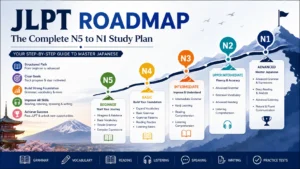
JLPT roadmap self-learning If you’ve typed “JLPT roadmap” into Google at 1 a.m. wondering how on earth you’re going to go from konnichiwa to reading a Japanese newspaper, you’re in the right place. This guide lays out a complete, realistic JLPT roadmap that takes you from absolute beginner (N5) all the way to near-native fluency (N1) — with timelines, monthly study plans, daily routines, and the resources that actually work.
The Japanese Language Proficiency Test (JLPT) is the most widely recognized benchmark for non-native Japanese ability, and this JLPT roadmap is built specifically for self-learners who don’t have a classroom, a tutor, or unlimited free time. Whether you’re studying for university, work, immigration, or simply because you love Japan, this JLPT study plan gives you a clear, level-by-level path — grounded in consistent practice, smart study habits, and measurable progress.
Let’s break down exactly what each JLPT level demands, how long it realistically takes, and what your study plan should look like at every stage of the journey from N5 to N1.
Click to Book Your Hostel in Tokyo
Table of Contents
What Is JLPT Roadmap Self-Learning?
The JLPT (Japanese Language Proficiency Test) is administered twice a year — usually in July and December — by the Japan Foundation and Japan Educational Exchanges and Services. It has five levels, N5 through N1, with N5 being the easiest and N1 the most advanced. Each level tests vocabulary, grammar, reading, and listening comprehension, though it does not test speaking or writing directly.
The problem most self-learners run into isn’t motivation — it’s structure. Without a clear JLPT roadmap, it’s easy to bounce between apps, burn out on kanji, or spend six months “learning Japanese” without ever knowing whether you’re actually N5-level or N3-level. A roadmap solves that by breaking the entire journey into level-based milestones, each with its own vocabulary targets, grammar points, and study duration.
This JLPT roadmap is designed around four principles: consistent daily practice, smart use of study time, real progress you can measure, and a study plan you can actually stick to as a self-learner juggling work, school, or family life.

JLPT Roadmap: The Levels at a Glance
Before diving into the study plan for each level, here’s the big-picture view of the entire JLPT roadmap from N5 to N1.
N5 — The Foundation Level
- Goal: Understand basic Japanese used in daily life.
- Duration: 2–3 months for most self-learners.
- Vocabulary: ~800 words.
- Grammar points: ~100.
- What you can do: Introduce yourself, understand simple sentences, and follow basic conversations.
N5 is where every JLPT roadmap begins. It’s the level most travelers and casual learners stop at, but for anyone serious about fluency, it’s simply the on-ramp.
N4 — Everyday Communication
- Goal: Understand everyday Japanese and basic information.
- Duration: 3–4 months.
- Vocabulary: ~1,500 words.
- Grammar points: ~300.
- What you can do: Hold daily conversations, read simple articles, and understand basic instructions.
Plan For Your Air Ticket to Tokyo
N3 — The Bridge Level
- Goal: Understand Japanese used in everyday situations with more nuance.
- Duration: 4–6 months.
- Vocabulary: ~3,750 words.
- Grammar points: ~650.
- What you can do: Follow general conversations, read short news stories, and handle most daily situations independently.
N3 is widely considered the hardest jump in any JLPT study plan, because the vocabulary and grammar load roughly doubles compared to N4.
N2 — Business and Academic Readiness
- Goal: Understand Japanese used in a wide range of situations.
- Duration: 6–8 months.
- Vocabulary: ~6,000 words.
- Grammar points: ~850.
- What you can do: Understand complex texts, news, and abstract topics; work or study in Japanese-language environments.
N2 is the level most commonly required for working in Japan or entering many Japanese university programs.
N1 — Near-Native Fluency
- Goal: Understand Japanese used in almost all situations, including abstract and specialized contexts.
- Duration: 8–12+ months.
- Vocabulary: ~10,000+ words.
- Grammar points: ~1,000+.
- What you can do: Read and listen to native-level content — novels, academic writing, and debates — with genuine fluency.
Altogether, a realistic JLPT roadmap from zero to N1 takes most dedicated self-learners 2 to 3.5 years, assuming consistent daily study. That might sound like a long time, but broken into level-by-level milestones, it becomes a series of manageable sprints rather than one overwhelming marathon.
The JLPT Study Plan: Level by Level
Now let’s get into the actual JLPT study plan — what to focus on, month by month, at each stage of your roadmap.
N5 Study Plan (2–3 Months)
Your N5 study plan should front-load the two things every future level depends on: the writing systems and foundational sentence structure.
- Weeks 1–3: Learn hiragana and katakana until you can read both fluently without hesitation. Don’t move on until this is automatic — every future study plan step depends on it.
- Weeks 3–8: Build basic vocabulary and grammar (particles like は, を, and に; the present and past tense of verbs; basic adjectives). Use a structured textbook or app-based course rather than random YouTube videos.
- Weeks 8–12: Practice listening and reading daily. Start speaking simple sentences out loud, even if it’s just to yourself. Take a full N5 mock test in the final week to identify weak spots.
By the end of this stage of your JLPT roadmap, you should comfortably introduce yourself, order food, ask for directions, and understand simple written signage and short conversations.
N4 Study Plan (3–4 Months)
The N4 study plan builds directly on N5 grammar but introduces more verb forms (て-form, potential form, conditional forms) and roughly double the vocabulary.
- Month 1: Expand vocabulary and grammar systematically — aim for 15–20 new words per day using spaced repetition.
- Month 2: Practice simple conversations daily, ideally with a language partner or tutor, even just once a week.
- Month 3: Read short passages (graded readers work well here) and increase listening time to at least 20–30 minutes daily.
- Month 4: Take official N4 mock tests under timed conditions and review every mistake.
By N4, your JLPT study plan should have you comfortable reading simple manga, following slow-paced anime with subtitles, and holding basic real-world conversations.
N3 Study Plan (4–6 Months)
N3 is the pivot point of the entire JLPT roadmap — this is where casual learners often stall, and where a genuinely structured study plan pays off.
- Months 1–2: Learn intermediate grammar patterns and start tackling kanji more seriously (aim for 5–10 new kanji per day with readings).
- Months 2–4: Sharply improve reading speed by reading daily — news headlines, blog posts, or graded N3 readers.
- Months 4–5: Add podcasts and native content to your listening rotation, even if you only catch 60–70% of it at first.
- Month 5–6: Take official N3 mock tests monthly and track your score trend, not just a single result.
N2 Study Plan (6–8 Months)
The N2 study plan shifts from “learning the language” to “using the language,” since N2 vocabulary and grammar overlap heavily with real-world Japanese media.
- Months 1–3: Learn advanced grammar and expand your kanji base toward the full N2 list (~1,000 kanji).
- Months 3–5: Read full articles and short essays regularly; start summarizing what you read in your own words.
- Months 5–7: Listen to native-speed content daily — podcasts, news broadcasts, or drama — without relying on subtitles.
- Months 7–8: Take official N2 mock tests biweekly and drill your weakest section relentlessly.
N1 Study Plan (8–12+ Months)
N1 is less about “new” Japanese and more about depth, speed, and nuance — this final stage of the JLPT roadmap rewards volume and consistency above all else.
- Months 1–4: Master advanced grammar patterns (many of which appear only in formal or written Japanese) and essay-level writing structures.
- Months 4–7: Read newspapers, novels, and long-form articles regularly, tracking new vocabulary in a dedicated notebook or app.
- Months 7–10: Listen to discussions, lectures, and unscripted native content daily to build real listening stamina.
- Months 10–12: Take official N1 mock tests under strict timed conditions monthly and refine your exam-day pacing strategy.
Reaching N1 doesn’t mean you’ll never learn another word of Japanese — it means you have the tools to keep learning independently, the same way a native speaker does.
Book Your Tourist Activities in Tokyo
Each JLPT Level Focus: The Four Study Sections
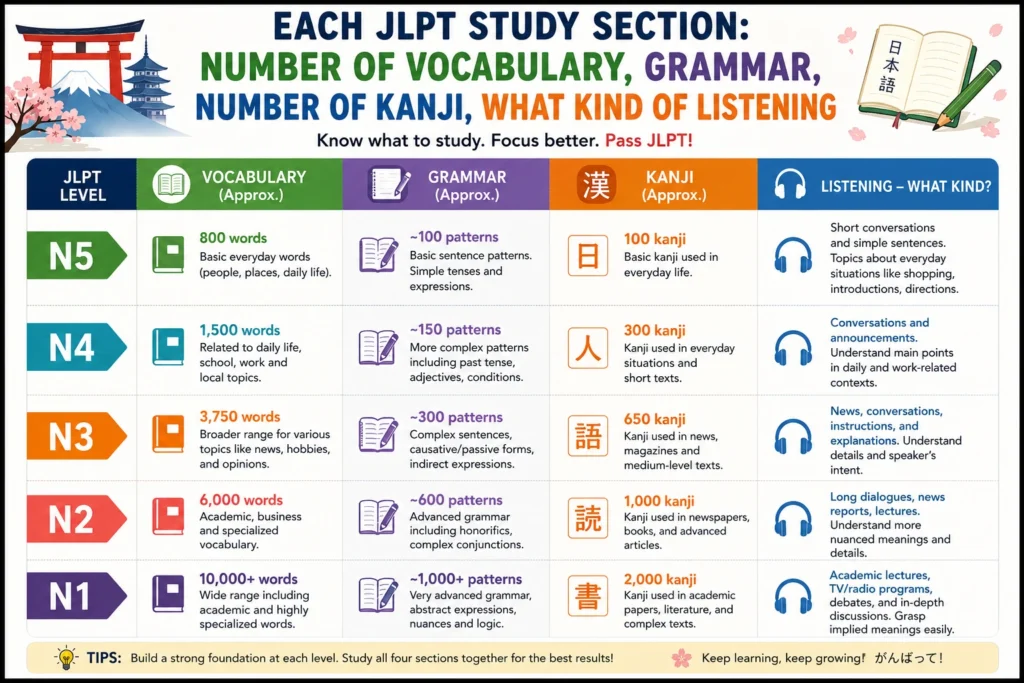
Every stage of this JLPT study plan should be built around four consistent pillars, no matter which level you’re on.
1. Language Knowledge (Vocabulary & Grammar)
Learn daily, take notes, and revise using spaced-repetition flashcards. Apps like Anki or Quizlet are ideal here because they automatically resurface words right before you’re likely to forget them — far more efficient than rereading a vocabulary list.
2. Reading
Start with short, simple passages and gradually increase length and complexity as you progress through your JLPT roadmap. Graded readers are especially useful at N5–N3, while native newspapers and essays become appropriate from N2 onward.
3. Listening
Practice with JLPT-style audio, anime, podcasts, and news for better comprehension. Listening is the skill self-learners neglect most, simply because it’s harder to “cram” — which is exactly why it needs a dedicated daily slot in your study plan.
4. Speaking & Writing
Although the JLPT doesn’t test speaking or writing, speaking Japanese as much as possible and writing daily diaries or short essays dramatically reinforces everything else you’re learning. Output-based practice is what turns passive recognition into active fluency.
Daily Study Routine (Sample)
Consistency beats intensity in any JLPT roadmap. Here’s a sample 100-minute daily routine that balances all four skill areas without requiring you to quit your job:
- 30 minutes — Vocabulary & Grammar: Flashcard review plus one new grammar point.
- 30 minutes — Reading Practice: A graded reader, news article, or textbook passage appropriate to your level.
- 30 minutes — Listening Practice: JLPT audio drills, a podcast, or anime with Japanese subtitles.
- 20 minutes — Speaking / Writing Practice: A short diary entry, shadowing practice, or a conversation with a language partner.
- 10 minutes — Review & Flashcards: A final spaced-repetition pass before bed, when retention is highest.
If 100 minutes feels unrealistic some days, protect at least the 30-minute vocabulary block — it’s the single highest-leverage habit in any JLPT study plan, because grammar and reading both depend on it.
Tips for Success on Your JLPT Roadmap

- Be consistent — study a little every day (1–2 hours) rather than cramming once a week. Consistency compounds; cramming doesn’t.
- Use good resources and stick to one path. Constantly switching textbooks or apps fragments your learning and wastes time re-learning the same basics in a different format.
- Practice all four skills — don’t neglect any section of the exam. It’s tempting to over-focus on vocabulary because it feels productive, but listening and reading speed win or lose the actual test.
- Take mock tests regularly and analyze mistakes. A mock test score only becomes useful once you’ve reviewed why each question was wrong.
- Review and revise — it’s the key to retention. New material sticks far better when it’s revisited within 24–48 hours, then again a week later.
- Surround yourself with Japanese — music, anime, news, packaging labels, anything. Passive exposure won’t replace active study, but it dramatically reinforces it.
Book Your Stay in Tokyo
Best Resources for Your JLPT Study Plan
A good JLPT roadmap is only as strong as the resources behind it. Here’s what real N5-to-N1 learners consistently recommend:
- Textbooks: Minna no Nihongo and Genki are the two most widely used structured textbook series for self-learners, covering everything from N5 through intermediate grammar.
- Grammar: Tae Kim’s Guide to Japanese Grammar is a free, thorough grammar reference that many learners use alongside their textbook.
- Vocabulary: Anki and the Tango N5–N1 vocabulary series are staples for spaced-repetition vocabulary building at every level.
- Practice tests: The JLPT Official Practice Book series from the Japan Foundation is the most accurate way to simulate real exam conditions.
- Listening: NHK Easy News offers simplified Japanese news articles with audio, and is one of the best free tools for bridging N3–N2 listening skills.
- Apps: Anki, LingoDeer, Duonao, and Quizlet all serve different purposes — LingoDeer is strong for structured N5–N3 grammar, while Anki excels at long-term vocabulary retention across every level.
If your reason for learning Japanese includes an eventual trip to Japan, it’s worth planning that visit around your JLPT roadmap milestones — for example, timing a trip after you clear N4 or N3, when you’ll actually be able to navigate, order, and chat with locals. If you’re mapping out that kind of trip, RydeTravel is a useful resource for planning travel logistics once your Japanese is ready to be put to the test in the real world.
Common Mistakes to Avoid in a JLPT Roadmap
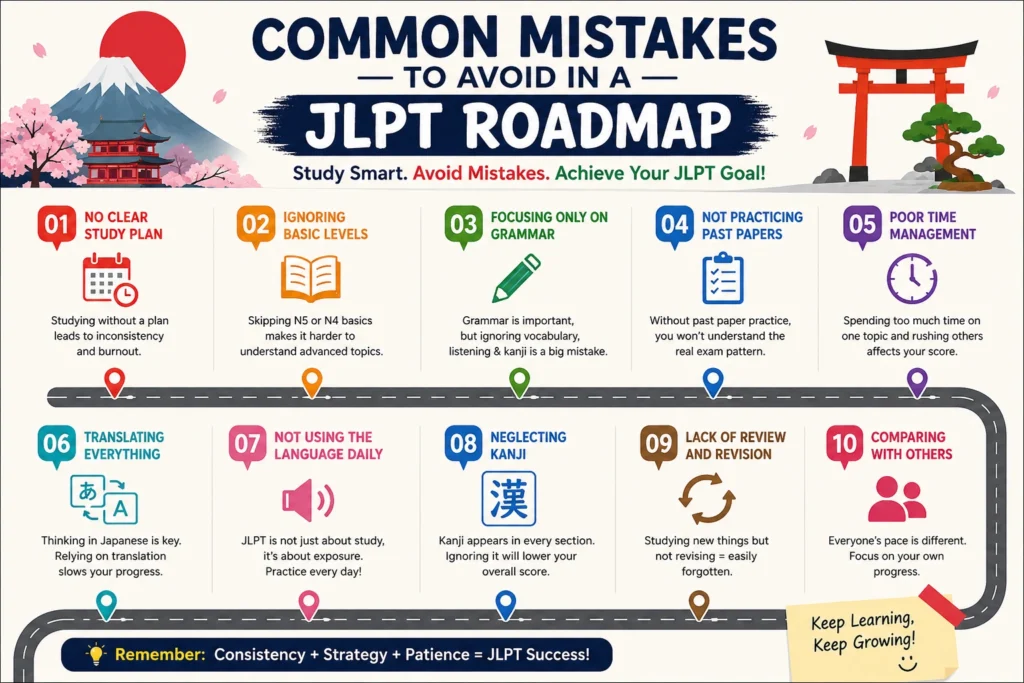
- Skipping kana and jumping straight to kanji. Without solid hiragana and katakana fluency, every later stage of the study plan becomes slower and more frustrating.
- Over-relying on apps without ever taking a full mock test. Apps are great for daily reps, but only timed, full-length mock tests reveal your real exam-day pacing.
- Ignoring listening practice. It’s the skill most self-learners under-invest in, and the one that costs the most points on test day.
- Studying passively. Watching anime without subtitles is helpful eventually, but it’s not a substitute for active flashcard review and grammar drilling, especially below N3.
- No review system. Learning new material without a spaced-repetition or revision plan means most of it will be forgotten within weeks.
Do I need a tutor for JLPT roadmap self-learning to work?
How long does the full JLPT roadmap from N5 to N1 take?
Most dedicated self-learners following a structured JLPT study plan take between 2 and 3.5 years to go from complete beginner to N1, depending on daily study time and consistency.
Can I skip levels in my JLPT roadmap?
echnically yes — you can register directly for any level — but skipping levels (e.g., going from N5 straight to N2) is only advisable if you already have strong prior exposure to Japanese, since each level in the JLPT roadmap builds directly on the vocabulary and grammar of the one before it.
Which JLPT level do I need for a job in Japan?
N2 is the most commonly requested level for professional roles in Japan, though some technical or bilingual positions accept N3, and academic or highly formal roles may prefer N1.
Is N3 really the hardest jump in the JLPT roadmap?
Many learners report N3 as the most difficult transition, simply because the vocabulary and grammar volume roughly doubles compared to N4, while study materials become noticeably less beginner-friendly.
Do I need a tutor to follow this JLPT study plan?
No — this JLPT roadmap is designed for self-learners. A tutor or language exchange partner can accelerate speaking practice, but every other component (vocabulary, grammar, reading, listening) can be self-studied effectively with the resources listed above.
Final Thoughts: Your JLPT Roadmap Starts Today

Every learner who has passed N1 started exactly where you are now — staring at hiragana for the first time, wondering if any of it would ever click. The difference between the people who reach N1 and the people who quit at N4 usually isn’t talent. It’s a JLPT roadmap they trusted and a study plan they actually followed, day after day, for a couple of years.
Pick your current level, follow the study plan above, protect your daily 30-minute vocabulary block, and revisit this roadmap whenever you need to recalibrate. Consistent practice, smart study, and real progress — that’s the whole formula. Now go put in today’s session.
Visit our other blogs
15 Amazing Osaka Tourist Places to Visit in 2026
10 Must-See Tourist Places in Tokyo, Japan You’ll Love

Leave a Reply