This guide contains affiliate links. We may earn a commission at no extra cost to you — see our Affiliate Disclosure and Affiliate Disclosure Policy for details.
Table of Contents
Click to Buy your eSim – 15% Special Discount
1. Why South Korea Visa Requirements Matter in 2026
Every year, thousands of Indian travelers book their dream Seoul-Busan-Jeju itinerary, only to realize at the last minute that they never checked the south korea visa requirements for their nationality. Unlike travelers from the UK, most of the EU, or the US, Indian citizens cannot walk into Incheon Airport without pre-approval. There is no visa-on-arrival and no K-ETA shortcut for India — a genuine, embassy-issued visa is mandatory.
That single fact changes your entire trip-planning timeline. Get it right, and your Korea trip unfolds exactly the way you imagined — palace tours in Seoul, seafood markets in Busan, and cherry blossoms or snow-capped peaks depending on the season. Get it wrong, and you could be facing a rejected application, a cancelled flight, or a family holiday thrown into chaos days before departure. This guide exists so that doesn’t happen to you.
2. List of Countries Covered Under South Korea’s Visa System
South Korea’s entry rules fall into three broad groups, and understanding which one applies to your passport is the first real step in meeting south korea visa requirements:
Group A — Visa-Free, K-ETA Exempt (22 nations, extended through 31 December 2026): This includes most of Western Europe (Germany, France, Italy, Spain, Netherlands, Switzerland, the UK), the United States, Canada, Australia, New Zealand, and a handful of others. Citizens of these countries can enter Korea for short tourist stays without a visa and without even applying for K-ETA, though applying voluntarily is still allowed for added convenience. None of the standard south korea visa requirements discussed in this guide apply to Group A passport holders. <cite index=”9-1″>Nationals from 67 countries and territories remain exempt from the K-ETA requirement in 2026, spanning most of the EU, several Gulf states, and Pacific nations such as Australia and New Zealand.</cite>
Group C — Visa Required (includes India): This is the group most relevant to Indian readers. <cite index=”5-1″>Indian citizens are not among the visa-exempt countries and must apply for a genuine C-3-9 tourist visa before traveling, since neither an eVisa nor a visa-on-arrival option is available to them.</cite> Other major markets in this category include China, most of Southeast Asia (except a few nations with special group-tour arrangements), and several African and South Asian countries — all subject to the same core south korea visa requirements covered below.
Book Your Tour Package in Seoul
The only exception within Korea for Indian passport holders is Jeju Island, which <cite index=”3-1″>allows visa-free entry for stays of up to 30 days</cite> — useful to know if you’re planning an island-only getaway, though it does not apply if your itinerary includes mainland cities like Seoul or Busan.
3. South Korea Visa Fee and Duration of Stay by Country/Category
South Korea doesn’t price visas by destination country in the way Schengen states do — instead, pricing depends on visa type and processing speed. Here’s what Indian applicants can expect under current south korea visa requirements:
| Visa Type | Purpose | Fee (approx.) | Service Charge | Stay Allowed |
|---|---|---|---|---|
| C-3-9 Tourist (Standard, Single Entry) | Leisure/tourism | ₹3,500 | ₹1,380 (VFS) | Up to 90 days |
| C-3-9 Tourist (Express, where available) | Leisure/tourism | ₹5,950 | Included | Up to 90 days |
| C-3-4 Business (Short Term) | Meetings, conferences | Similar to tourist tier | VFS/BLS charges apply | Up to 90 days |
| C-3-2 Group Tourist | Group leisure travel | Processing fee waived through 30 June 2026 | Group facilitation fee may apply | Up to 90 days |
| Multiple Entry Tourist/Business | Repeat travel | Higher tier fee, case-by-case | VFS/BLS charges apply | Up to 90 days per entry, validity 1–5 years |
| D-2/D-4 Student | Study programs | Category-specific fee | VFS/BLS charges apply | Course duration |
| E-Series Work Visa | Employment | Category-specific fee | VFS/BLS charges apply | Contract duration |
| F-2 Residence (Points-Based) | Long-term settlement | Category-specific fee | VFS/BLS charges apply | Long-term/renewable |
A few numbers worth remembering when you’re budgeting for south korea visa requirements in 2026:
- <cite index=”5-1″>Total cost for the standard tourist visa is roughly INR 3,400 plus an INR 1,100–1,380 service charge, depending on the application centre.</cite>
- <cite index=”2-1″>Most Indian tourists opt for the single-entry C-3-9 visa priced around ₹4,500 all-in, which covers the entire country from Seoul’s palaces to Busan’s beaches.</cite>
- <cite index=”6-1″>Group tourists from India travelling on C-3-2 visas currently benefit from a processing-fee waiver, extended through the end of June 2026, as part of South Korea’s push to boost inbound tourism.</cite>
- Standard tourist and business visas allow a maximum single-entry stay of 90 days, though most leisure itineraries only need 7–14 days.
4. South Korea Visa Requirements vs K-ETA: What Applies to You
This is one of the most misunderstood parts of south korea visa requirements, so let’s be direct: for Indian passport holders, neither visa-on-arrival nor K-ETA is an option. <cite index=”2-1″>There is no separate K-ETA requirement for Indian citizens because the physical visa itself already serves as the entry authorization, and travelers should be cautious of third-party websites that offer “K-ETA assistance” for Indian passports — it simply does not apply to them.</cite>
K-ETA (Korea Electronic Travel Authorization) is only relevant to travelers from Group A and Group B countries listed above — mostly Europe, North America, and other visa-waiver nations. If you’re reading this as an Indian traveler comparing notes with a European friend who mentions applying for K-ETA in five minutes online, understand that this doesn’t apply to your passport; you need the full visa route instead.
Quick comparison for context (useful if your trip also includes Europe): Many Indian travelers combine South Korea with a European leg on the same journey. If that’s you, remember Europe’s own upcoming entry system — the ETIAS (often referred to loosely as the new “Europe travel permit”) — works similarly to K-ETA but is a separate application entirely, tied to the Schengen area, not to Korea. Neither K-ETA nor the Europe travel permit removes your need for an actual embassy-issued Schengen visa if you’re an Indian passport holder, just as neither removes the need for a proper Korean visa. Two separate systems, two separate applications — plan both well ahead if your trip spans continents.
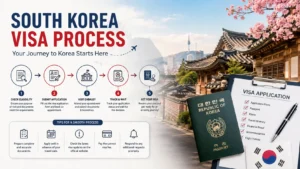
5. How to Apply for South Korea Visa From India (Step-by-Step)
Here is the practical, no-surprises walkthrough for meeting south korea visa requirements as an Indian applicant:
Step 1: Choose your visa category. Tourism → C-3-9. Business meetings/conferences → C-3-4. Group leisure travel → C-3-2. Confirm which one matches your actual purpose of travel, since the wrong category is a common cause of delay under current south korea visa requirements.
Book Your Stay in Seoul
Step 2: Book your VFS Global or BLS International appointment. <cite index=”3-1″>Applications are submitted in person at VFS Global or BLS International visa application centres across six Indian cities, including Delhi, Mumbai, Kolkata, Chennai, Bengaluru, and Hyderabad.</cite> <cite index=”1-1″>Applicants must visit the official Korea Visa Application Centre in their city — for example, Kolkata — or any other VFS Global centre across India.</cite>
Step 3: Gather your documents. A standard tourist application typically requires:
- Passport valid for at least 6 months beyond your travel dates, with 2 blank pages
- Passport-size photograph meeting Korean visa specifications
- Completed visa application form
- Confirmed round-trip flight reservation
- Hotel bookings or accommodation proof for the full stay
- Detailed day-by-day itinerary
- <cite index=”5-1″>Bank statements for the last six months, along with proof of income tax returns (ITR)</cite>
- <cite index=”4-1″>Employment letter on company letterhead stating designation, salary, tenure, and approved leave dates — self-employed applicants should instead submit business registration documents and ITR</cite>
Step 4: Pay the visa fee and service charge. <cite index=”5-1″>Payment is accepted by cash or card directly at the visa application centre.</cite>
Step 5: Submit biometrics if required, and wait for processing. Applicants are notified by SMS/email once a decision is made.
Step 6: Collect your passport with the visa. <cite index=”1-1″>Indian citizens are still required to receive a physical visa document rather than a simple e-visa sticker, even as Korea moves toward digital processes for other nationalities.</cite>
Pro tip: Strengthen your application with genuine tourism intent — <cite index=”5-1″>mention specific landmarks like Gyeongbokgung Palace, Bukchon Hanok Village, or Namsan Tower in your itinerary</cite>, since vague plans are a red flag to visa officers reviewing south korea visa requirements documentation.
6. When to Apply and How Long It Takes
Timing is everything when it comes to south korea visa requirements, especially since processing windows shift seasonally.
- Standard processing: 5–7 working days for single-entry visas and 7–10 working days for multiple-entry visas.
- Peak season delays: During April–May and October–November, processing can stretch up to 15 working days due to higher application volumes.
- Express processing: Express or urgent processing is currently suspended at several centres, including Delhi and Kolkata, so don’t count on a fast-track option being available. The embassy does not officially guarantee express processing for tourist visas in any case.
Recommended timeline: Apply 3 to 4 weeks before your intended departure date to comfortably absorb any peak-season slowdown, document resubmission requests, or public holiday closures at the visa center. Booking flights and hotels before your visa is approved is necessary for the application itself, but always choose refundable or flexible options until your visa is confirmed.
There is no online tracking portal for applications submitted in India — status checks require contacting the embassy or consulate directly by phone or email. Factor this into your planning; don’t assume you’ll get real-time updates the way you might with some other visa systems.
7. South Korea Visa Requirements: Good-to-Know Points for Tourists, Families, and Business Travelers
Not every traveler faces the same south korea visa requirements in practice — here’s how the process plays out for each group.
For Tourists:
- Approval odds are strong if your paperwork is solid — approximately 87% of Indian applications are approved when documentation is complete and consistent.
- Officers like to see genuine trip planning, not generic templates. Name real neighborhoods, temples, and attractions in your itinerary.
- If you’re pairing Korea with an onward European leg, apply for each visa independently and never assume one “travel permit” covers both regions — Korea’s visa and any European Schengen visa or Europe travel permit are entirely separate approval chains.
For Families:
- Children’s applications typically require the same documentation set as adults, plus birth certificates and, in shared-custody situations, consent letters from both parents.
- Because Jeju Island offers 30-day visa-free entry for Indian passport holders, some families use it as a lower-friction add-on if the mainland visa timeline feels tight — but this only works if your itinerary genuinely stays on Jeju.
- Book family accommodation and activities that reflect your real itinerary; visa officers may cross-check hotel bookings against family size and dates.
For Business Travelers:
- The C-3-4 short-term business visa needs an invitation letter from the Korean host company in addition to standard financial and employment documents.
- If your work is longer-term — like the E-7 professional visa route common for Indian IT professionals in Seoul’s Gangnam and Pangyo tech corridors — you’ll need an employment contract and a CSR (Confirmation of Visa Issuance) from Korea Immigration, which is a different process from the short-term business visa.
- Previous travel history to developed countries such as the US, UK, Japan, or Australia meaningfully strengthens a business or tourist application, even though first-time international travelers are not disqualified.
Book Your Local Travel
8. Common Problems Travelers Face With South Korea Visa Requirements
Understanding south korea visa requirements also means knowing where applications commonly stumble:
- Weak financial documentation: Large, sudden deposits just before applying look suspicious to visa officers; a steady, consistent bank balance over several months is far more convincing.
- Vague itineraries: “Visiting South Korea for tourism” without named cities, dates, or attractions raises red flags.
- Mismatched employment details: Leave letters that don’t match your stated travel dates, or salary slips that don’t align with your bank statements, are a frequent cause of delay or rejection.
- Confusing K-ETA with the actual visa: As covered above, K-ETA simply does not apply to Indian passports — applicants who mistakenly fill out K-ETA forms waste time and sometimes money on third-party “assistance” sites that have no bearing on their real application.
- Underestimating processing time during peak season: Applying too close to departure during April–May or October–November is one of the most common — and most avoidable — mistakes.
- Express processing assumptions: Assuming a rush option will always be available, when it’s frequently suspended at major centres including Delhi and Kolkata.
- Passport validity gaps: Applying with a passport that has fewer than six months of validity remaining, or fewer than two blank visa pages.
9. Multiple Entry South Korea Visa Rules
Frequent visitors — business travelers, those with family in Korea, or serial tourists — should understand the multiple-entry pathway within south korea visa requirements:
- Multiple-entry visas allow repeat visits within the visa’s overall validity window, which can range from one to five years depending on your travel history, purpose, and the discretion of the issuing consulate.
- Each individual entry is still capped at a maximum stay of 90 days, and you cannot extend that stay from inside the country — you must exit and re-enter to reset the clock.
- Multiple-entry applications generally require stronger supporting documentation than single-entry ones, including a clear explanation of why repeat travel is necessary (recurring business, family ties, or a demonstrated travel pattern).
- Processing for multiple-entry visas takes 7–10 working days, slightly longer than the single-entry standard.
- Multiple-entry visa holders are not exempt from any other entry requirement — you’ll still need valid travel insurance, a completed e-Arrival Card, and (where applicable) a Q-Code for quarantine screening on each individual trip, since these sit alongside your core south korea visa requirements, not instead of them.
- Business travelers on repeat work assignments should confirm with their sponsoring company whether a multiple-entry C-3-4 visa or a longer E-series work visa is the more appropriate category — using a short-term visa for what is effectively ongoing employment can cause problems at immigration.
10. Travel Insurance for South Korea Visa Travelers
While travel insurance isn’t always listed as a strict document under standard south korea visa requirements, it plays a bigger role than most applicants realize:
- Strengthens your application: Proof of travel insurance signals genuine, well-planned travel intent to the visa officer reviewing your file.
- Protects against high medical costs: South Korea’s healthcare system is excellent but expensive for foreigners without coverage — a simple ER visit or a lost-luggage claim can otherwise become a costly headache abroad.
- Covers trip disruptions: Flight cancellations, missed connections, or sudden itinerary changes are increasingly common; insurance protects your prepaid hotel and tour bookings.
- Look for a policy that includes: Minimum medical coverage of USD 30,000–50,000, COVID-related and general illness coverage, trip cancellation/interruption, baggage loss, and emergency evacuation.
- For families: Confirm the policy explicitly covers minors and, if traveling with elderly parents, check for any age-related exclusions or higher premiums.
- For business travelers: Corporate travel policies often already include Korea; double-check coverage limits match Korean hospital costs, not just a generic global average.
Buying insurance before your visa appointment — not after — means you can include the policy document as part of a stronger overall application.
11. South Korea Travel Tips for a Smooth Trip
Once you’ve cleared south korea visa requirements and your visa is sorted, here’s how to make the actual trip effortless:
- Download essential apps before you land: Papago for translation and Naver Maps for navigation, since Google Maps has limited functionality inside South Korea.
- Carry some Korean Won on arrival: Cards are widely accepted, but small vendors, temples, and local markets often prefer cash.
- Budget realistically: Plan for roughly ₹5,000–8,000 per day for a mid-range travel style, though budget travelers eating local food and using public transport can comfortably stay under ₹3,000 a day.
- Safety: South Korea is consistently ranked among the world’s safer countries, with very low crime rates, women-only subway sections during late hours, and safe solo travel even at night in cities like Seoul and Busan. Standard city-travel awareness still applies, as it would anywhere.
- Direct flights are available: Air India, Korean Air, and Asiana operate direct flights from Delhi and Mumbai to Seoul Incheon, with a flight time of roughly 6–7 hours.
- Complete your e-Arrival Card in advance: Korea’s digital arrival declaration can be filled up to three days before landing, saving time at immigration.
- Time your trip around the seasons: Spring (cherry blossoms, March–April) and autumn (fall foliage, October–November) are the most popular — and also the periods when visa processing runs slowest, so plan documentation extra early.
- Combine cities wisely: Seoul for culture and nightlife, Busan for beaches and seafood, Jeju for nature — a two-city or three-city itinerary is realistic within a 7–10 day trip.
12. Frequently Asked Questions
Q1: What are the South Korea visa requirements for Indian citizens in 2026?
Indian citizens need a genuine C-3-9 tourist visa (or the relevant category for business, study, or work) issued by a Korean consulate through VFS Global or BLS International. There’s no visa-on-arrival, e-visa, or K-ETA option for India.
Q2: How much does a South Korea tourist visa cost from India?
The standard single-entry tourist visa costs around ₹3,400 in visa fees plus a service charge of roughly ₹1,100–1,380, bringing the total to approximately ₹4,500–4,800.
Q3: Can Indians get a South Korea visa on arrival?
No. India is not on South Korea’s visa-waiver or K-ETA-exempt list, so a pre-approved visa is mandatory before departure — with the sole exception of Jeju Island, which allows 30 days of visa-free entry.
Q4: How long does South Korea visa processing take for Indian applicants?
Standard processing takes 5–7 working days for single entry and 7–10 working days for multiple entry, extending up to 15 working days during peak seasons (April–May and October–November).
Q5: How early should I apply for a South Korea visa from India?
Apply at least 3–4 weeks before your travel date to allow for peak-season delays, possible document resubmission, and processing-centre holidays.
Q6: What is K-ETA, and does it apply to Indian travelers?
K-ETA is Korea’s Electronic Travel Authorization for citizens of visa-waiver countries. It does not apply to Indian passport holders — Indians need a full visa instead, not K-ETA.
Q7: Is travel insurance mandatory for a South Korea visa application?
It’s not always a strict mandatory document, but it significantly strengthens your application and is strongly recommended for medical, trip-cancellation, and baggage protection while in Korea.
Q8: Can I get a multiple-entry South Korea visa as a first-time traveler?
It’s possible but less common under standard south korea visa requirements; multiple-entry visas are more easily approved for applicants with prior international travel history, ongoing business ties, or family connections in Korea. First-time travelers are usually issued single-entry visas.
Book Your Air Ticket
13. Official Government and Travel Resources
For the most current, authoritative details on south korea visa requirements beyond this guide, always verify directly with official sources before finalizing your trip:
- Korea Visa Portal – Ministry of Foreign Affairs — official visa categories, forms, and requirements
- K-ETA Official Portal — for travelers from visa-waiver countries only
- Hi Korea – Immigration & Visa Information — Korea Immigration Service resources
- Embassy of the Republic of Korea in India — consular guidance for Indian applicants
- VFS Global – South Korea Visa Application (India) — appointment booking and document checklists
- Korea Tourism Organization — official tourism information and itinerary ideas
- Korea e-Arrival Card — mandatory digital arrival declaration
- IATA Travel Centre — cross-check entry requirements across multiple countries, useful for multi-destination trips
Final Thoughts
Meeting south korea visa requirements doesn’t have to feel overwhelming. Once you understand which group your passport falls into, gather the right documents, and give yourself a realistic timeline, the process is genuinely straightforward — thousands of Indian travelers navigate it successfully every month.
Whether you’re a solo tourist chasing cherry blossoms, a family planning your first big international trip, or a business traveler heading to Gangnam for meetings, the key is the same: start early and document honestly.
Don’t confuse Korea’s visa system with K-ETA, and don’t confuse it with any separate Europe travel permit you might also need for a connecting leg of your journey. Get the south korea visa requirements right, and your trip will start the way it should — with excitement, not stress.
Related Reads on RydeTravel
Planning a longer Asia or Korea-Europe combined trip? These related guides on rydetravel.com can help you plan the rest of your itinerary:
- Top 10 Places You Must Visit in Daegu: Ultimate 2026 Guide
- Best South Korea Tourist Places You Must Explore
- Best 10 Places to Visit in South Korea: Seasonal Guide 2026
- Schengen Visa Guide 2026: Requirements & Tips






Leave a Reply