This guide contains affiliate links. We may earn a commission at no extra cost to you — see our Affiliate Disclosure and Affiliate Disclosure Policy for details.
Quick Take: A Visa on Arrival is obtained in cash at the airport counter upon landing, while an ETA is a pre-approved digital authorization applied for online before departure — and choosing the right one for your Asia Pacific destination can save you hours in queues or a denied entry.
Key Highlights:
- VOA fees range roughly USD $25–$80 (e.g., Thailand THB 2,000, Indonesia IDR 500,000) and take 15–90 minutes at the counter, while ETAs cost about USD $10–$100 and process anywhere from instant to 7 days.
- Always apply for an ETA at least 7–14 days before departure — India’s e-Visa alone needs 72–96 hours — and only through official .gov portals, since third-party sites often charge 2–3x the real fee.
- Insider tip: Every infant needs their own separate ETA or VOA — babies can’t travel under a parent’s visa — so apply for their documents at the same time as your own, ideally 3+ weeks ahead.
To book your stay, click here. To Book Local Travel, click here
Traveling Overseas click here to buy a eSIM. For more info click here
Planning a trip to Asia Pacific and confused about whether you need a Visa on Arrival or an Electronic Travel Authorization? You’re not alone. Every year, thousands of tourists and business travelers miss flights, face immigration delays, or pay unnecessary fees simply because they didn’t understand the difference. This guide breaks it all down — clearly, completely, and with zero jargon — so you can travel with confidence.
To book your stay, click here. To Book Local Travel, click here
Traveling Overseas click here to buy a eSIM. For more info click here
Imagine landing after a long-haul flight, walking up to an immigration counter, and getting your visa stamped right there and then. That’s exactly what a Visa on Arrival (VOA) is. It’s a visa issued to eligible travelers at the port of entry — an international airport, seaport, or land border crossing — upon arrival in the destination country.
Table of Contents
What Is a Visa on Arrival (VOA)? Everything You Need to Know
A VOA means you don’t need to visit an embassy or apply weeks in advance. However, it does not mean it’s completely paperwork-free. You’ll still need to fill out an arrival form, pay a fee (usually in cash or card at the counter), and meet certain eligibility conditions.
Who Is Eligible for Visa on Arrival?
Eligibility varies by country, but in most Asia Pacific destinations, a VOA is available to:
- Citizens of countries on the destination nation’s approved VOA list
- Tourists, short-term business visitors, and transit passengers
- Holders of valid passports with at least 6 months validity
- Travelers with sufficient funds and a return/onward ticket
- Individuals without a history of visa violations in the destination country
The Visa on Arrival Process — Step by Step
- Arrive at the international entry point (airport/seaport)
- Proceed to the VOA counter (look for “Visa on Arrival” signs before the main immigration line)
- Submit your documents: passport, filled arrival card, passport-size photo, proof of accommodation, and return ticket
- Pay the VOA fee (cash in local currency or USD is usually preferred; some counters accept cards)
- Receive your visa stamp or sticker in your passport
- Proceed to main immigration for entry stamp
The entire process takes anywhere from 15 minutes to over an hour depending on the airport’s crowd level. During peak tourist seasons, VOA queues in places like Bali or Bangkok can stretch to 90 minutes or more. Plan accordingly.
What Is an Electronic Travel Authorization (ETA)? The Smart Traveler’s Pre-Entry Permit
Think of an Electronic Travel Authorization (ETA) as your digital permission slip — applied for online before you even pack your bags. Unlike a traditional visa, an ETA is electronically linked to your passport and doesn’t require a physical stamp or sticker. It’s fast, paperless, and increasingly the preferred entry method for tourism-friendly nations.
Book Your Accommodation
An ETA is not a visa in the traditional sense — it’s a pre-screening system that verifies you’re eligible to board a flight to that country. When you arrive, immigration officers can check your ETA status electronically in seconds.
Who Is Eligible for an ETA?
Each country sets its own ETA eligibility rules, but common criteria include:
- Citizens of eligible countries (usually listed on the government’s official visa portal)
- Tourists, short-term business travelers, and transit passengers
- Holders of biometric or e-passport (required by some countries like Australia)
- Travelers with a clean immigration and criminal record
- Individuals applying for tourism, business meetings, or family visits (not for employment)
The ETA Application Process — Step by Step
- Visit the official government ETA portal of the destination country
- Create an account or apply as a guest
- Upload a scanned copy of your passport (and sometimes a photo)
- Fill in your personal and passport details
- Pay the ETA fee online via credit/debit card
- Receive your ETA confirmation via email (keep a printed or digital copy)
- Travel and present your passport at immigration — your ETA is already linked
How Long Does ETA Approval Take?
This is where ETAs vary most significantly by country:
Select City and Book your Activity
- Australia (eVisitor/ETA): Usually within minutes to 24 hours; can take up to 7 days
- India (e-Visa): Typically 72–96 hours (apply at least 4 days before travel)
- Sri Lanka (ETA): Usually within 24 hours; often instant
- Cambodia (e-Visa): 3 business days
- New Zealand (NZeTA): Typically within 72 hours
- Malaysia (eNTRI/eVISA): Within 1 hour to 24 hours
⚠️ Always apply at least 7–14 days before your departure to account for any system delays or requests for additional documents.
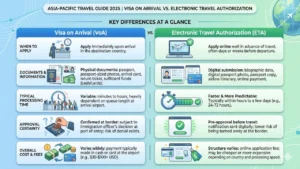
Visa on Arrival vs Electronic Travel Authorization: Key Differences at a Glance
| Feature | Visa on Arrival (VOA) | Electronic Travel Authorization (ETA) |
|---|---|---|
| Where Applied | At the airport/port of entry upon arrival | Online before departure from home country |
| When to Apply | No advance application needed | Days to weeks before travel |
| Processing Time | 15–90 minutes at the counter | Instant to 7 days (varies by country) |
| Format | Physical stamp or sticker in passport | Digital/electronic — no stamp needed |
| Documents Needed | Passport, photo, arrival form, return ticket, cash for fee | Passport scan, online form, card payment |
| Risk of Denial | Can be denied at the counter — causes travel disruption | Pre-screened — lower risk if approved before departure |
| Multiple Entries | Usually single entry | Can be single or multiple entry depending on country |
| Suitable For | Spontaneous travelers, last-minute trips | Planned travelers, peace-of-mind pre-clearance |
| Cost Range | USD $25–$80 typical | USD $10–$100 typical (varies widely) |
| Business Travelers | Acceptable for short visits; risky without backup plan | Preferred — can be processed well in advance |
| ePassport Required | Usually not required | Required by some countries (e.g., Australia) |
Top 6 Asia Pacific Countries with Electronic Travel Authorization (ETA) for Tourists & Business Travelers
These six countries represent the most visited destinations in Asia Pacific and all offer an ETA system for eligible passport holders. Whether you’re chasing beaches, boardrooms, or Buddhist temples, here’s what you need to know before you go.
1. 🇦🇺 Australia — eVisitor / ETA
| Visa Fee | eVisitor (subclass 651): Free | ETA (subclass 601): AUD 20 (~USD 13) service charge via app |
| Allowed Stay | Up to 3 months per visit (multiple entries within 12 months) |
| Processing Time | Usually within minutes to 24 hours; can take up to 7 days |
| How Early to Apply | Can apply up to 12 months before travel; recommended at least 14 days before departure |
| Official Portal | Australian Department of Home Affairs — ETA |
✅ Good to Know: Australia’s ETA is only available to passport holders from specific countries (including USA, UK, Canada, Japan, South Korea, and more). You must hold a biometric passport. The eVisitor is available to European Union and select European passport holders at no cost. Business visitors can attend meetings, conferences, and negotiations — but not work or earn income. Apply via the official Australian ETA app or through the Home Affairs website.
2. 🇮🇳 India — e-Visa (Tourist / Business / Medical)
| Visa Fee | USD $10–$100 depending on nationality and visa type; most countries USD $25–$80 |
| Allowed Stay | 30 days (double entry) for most; 1-year and 5-year e-visas available with 90-day stays per visit |
| Processing Time | 72–96 hours (3–4 business days) |
| How Early to Apply | Apply at least 4 days and no earlier than 120 days before arrival |
| Official Portal | Indian Government e-Visa Portal |
✅ Good to Know: India’s e-Visa is valid for entry at 28 designated airports and 5 seaports. The Business e-Visa allows attending meetings, trade fairs, and setting up industrial/business ventures. Always use the official government portal — third-party sites often charge inflated fees. Citizens of Pakistan, Afghanistan, and a few others are not eligible. India is a top destination for wellness tourism, heritage travel, and tech business conferences.
Book Your Local Transport
3. 🇱🇰 Sri Lanka — Electronic Travel Authorization (ETA)
| Visa Fee | USD $20 (Tourist) / USD $40 (Business) |
| Allowed Stay | 30 days, extendable up to 6 months in-country |
| Processing Time | Usually within 24 hours; often instant |
| How Early to Apply | Can apply up to 3 months before travel; recommended at least 7 days before |
| Official Portal | Sri Lanka ETA Official Portal |
✅ Good to Know: Sri Lanka is one of the most affordable ETA destinations in Asia Pacific. Citizens of Singapore, Maldives, and a few other SAARC countries get free entry. The double-entry tourist ETA costs USD $35. Sri Lanka is famous for UNESCO-listed ancient cities, wildlife safaris, and pristine beaches — perfect for extended itineraries. Business visitors can attend meetings and seminars but cannot take up employment.
4. 🇰🇭 Cambodia — e-Visa
| Visa Fee | USD $30 (Tourism) + USD $6 processing fee = USD $36 total |
| Allowed Stay | 30 days from date of entry (single entry) |
| Processing Time | 3 business days |
| How Early to Apply | Apply at least 7 days before travel; applications accepted up to 90 days in advance |
| Official Portal | Cambodia e-Visa Official Portal |
✅ Good to Know: Cambodia’s e-Visa is valid for entry at Phnom Penh International Airport, Siem Reap International Airport, and Sihanoukville International Airport only — not all land borders. Home to the iconic Angkor Wat complex, Cambodia attracts millions of visitors annually. Tourists should carry a printed copy of their e-Visa approval. The country also offers a 30-day Visa on Arrival as an alternative. US dollars are widely accepted as a parallel currency.
5. 🇳🇿 New Zealand — NZeTA (New Zealand Electronic Travel Authority)
| Visa Fee | NZD 17 (~USD 10) via app / NZD 23 (~USD 14) via website + IVL (International Visitor Levy) NZD 35 (~USD 21) |
| Allowed Stay | Up to 90 days per visit (valid for 2 years with multiple entries) |
| Processing Time | Usually within 72 hours; can take up to 10 days |
| How Early to Apply | Apply at least 72 hours before departure; recommended 2 weeks before |
| Official Portal | New Zealand Immigration — NZeTA |
✅ Good to Know: New Zealand’s NZeTA is mandatory for visa-waiver country citizens, including travelers from the USA, UK, EU, Canada, Japan, and Singapore. The International Visitor Levy (IVL) is an additional conservation and tourism infrastructure fee — it’s not the NZeTA fee itself. New Zealand is a dream destination for adventure tourism, film tourism (Lord of the Rings), and eco-travel. Transit passengers also need an NZeTA if they’re a visa-waiver national.
6. 🇲🇾 Malaysia — eNTRI / Malaysia eVISA
| Visa Fee | eNTRI (India/China citizens): RM 35 (~USD 8) | eVISA: RM 200–500 (~USD 45–115) depending on nationality |
| Allowed Stay | eNTRI: 15 days | eVISA: 30 days single / 90 days multiple |
| Processing Time | Within 1 hour to 24 hours |
| How Early to Apply | Apply at least 3 days before travel; available up to 3 months in advance |
| Official Portal | Malaysia eVisa — Window Malaysia |
✅ Good to Know: Malaysia is visa-free for citizens of over 160 countries for stays up to 90 days — always check your passport first before applying for an eVISA. The eNTRI program is specifically for Indian and Chinese passport holders. Kuala Lumpur, Penang, and the Borneo states of Sabah and Sarawak are top tourist draws. The eVISA is mainly applicable to nationals from countries without a bilateral visa-free agreement.
Top 6 Asia Pacific Countries with Visa on Arrival for Tourists & Business Travelers
Sometimes, the best adventures are the unplanned ones. These six countries make spontaneous travel possible with hassle-free Visa on Arrival options — but knowing the fees, requirements, and queues in advance can save you a lot of stress at immigration.
Book Your Activities in Thailand
1. 🇹🇭 Thailand — Visa on Arrival
| Visa Fee | THB 2,000 (~USD 55) |
| Allowed Stay | 15 days |
| Processing Time | 30–90 minutes at the counter |
| How Early to Apply | N/A — applied at the port of entry upon arrival |
| Official Information | Thailand Immigration Bureau — VOA |
✅ Good to Know: Thailand’s VOA is available at major airports including Suvarnabhumi (Bangkok) and Phuket International. Note that many nationalities (USA, UK, EU, Australia) actually get 30–60 days visa-free — always check if you even need a VOA. The VOA is specifically for nationals of around 19 countries including China, India, Saudi Arabia, and Taiwan. Have one passport-size photo and proof of accommodation ready. Cash (Thai Baht or USD) is required at the counter.
2. 🇮🇩 Indonesia — Visa on Arrival (Bali & Major Airports)
| Visa Fee | IDR 500,000 (~USD 30) |
| Allowed Stay | 30 days, extendable once for another 30 days |
| Processing Time | 30–60 minutes at the counter |
| How Early to Apply | N/A — at arrival; or apply for e-VOA online before departure for faster processing |
| Official Information | Indonesia Immigration — e-VOA Portal |
✅ Good to Know: Indonesia has smartly introduced an e-VOA (electronic Visa on Arrival) allowing travelers to pay online in advance and skip the cash queue at Bali’s Ngurah Rai airport. This is strongly recommended during peak season (July–August, December–January) when queues can exceed 2 hours. The VOA is available to citizens of 92 countries. Indonesia also offers free visa-free access for 169 countries for up to 30 days from mid-2023 — verify your eligibility first.
3. 🇲🇻 Maldives — Free Visa on Arrival
| Visa Fee | Free (USD 0) — all nationalities |
| Allowed Stay | 30 days, extendable to 90 days |
| Processing Time | 10–20 minutes (very fast) |
| How Early to Apply | N/A — issued on arrival; no pre-application needed |
| Official Information | Maldives Immigration Official Site |
✅ Good to Know: The Maldives is one of the most traveler-friendly nations in the world — every nationality gets a free 30-day VOA. You’ll need proof of accommodation (resort or hotel booking confirmation), a valid return ticket, and sufficient funds (USD 100 per day minimum recommended). The Maldives is a top destination for honeymooners, luxury divers, and overwater villa seekers. Most resorts arrange airport transfers — confirm this in advance as seaplane and speedboat transfers are separate.
4. 🇳🇵 Nepal — Visa on Arrival
| Visa Fee | USD $30 (15 days) / USD $50 (30 days) / USD $125 (90 days) |
| Allowed Stay | 15, 30, or 90 days (your choice at arrival) |
| Processing Time | 30–60 minutes; pre-fill online form at NepaliPort to speed up |
| How Early to Apply | N/A — at arrival; online pre-registration at NepaliPort available |
| Official Information | Nepal Department of Immigration |
✅ Good to Know: Nepal’s VOA is available to most nationalities except Indian citizens (who travel visa-free) and certain restricted nationalities. Nepal offers the unique option of choosing your visa duration at the counter. The country is the gateway to Everest Base Camp, Annapurna Circuit, and countless trekking adventures. Citizens of SAARC countries get discounted or free visas. Pre-filling the NepaliPort online form before you fly significantly reduces queue time at Tribhuvan International Airport.
5. 🇯🇵 Japan — Free Entry / Visa-Waiver (Select Countries)
| Visa Fee | Free (for visa-exempt countries); Visa on arrival not available — exempt entry at border |
| Allowed Stay | 15–90 days depending on nationality |
| Processing Time | Immigration clearance 10–30 minutes |
| How Early to Apply | N/A — no pre-registration required for visa-exempt travelers; Japan is introducing a Visit Japan Web system for advance registration |
| Official Information | Japan Ministry of Foreign Affairs — Visa Information |
✅ Good to Know: Japan is technically a visa-waiver destination (not a traditional VOA), but worth including as travelers from 68+ countries can enter freely at the border for tourism and short-term business. Japan is currently rolling out its Visit Japan Web pre-registration for smoother immigration. Post-2023, Japan has seen record tourist numbers — book accommodations well in advance, especially during cherry blossom (March–April) and autumn foliage (November) seasons.
Book Your Activities
6. 🇵🇭 Philippines — Visa on Arrival / Visa-Free Entry
| Visa Fee | Free for visa-free nationals; USD $30 for VOA (select countries) |
| Allowed Stay | 30 days (extendable to 59 days and beyond through immigration) |
| Processing Time | 15–45 minutes at NAIA or Cebu airport |
| How Early to Apply | N/A — at arrival; eTravel registration at etravel.gov.ph must be completed 72 hours before arrival |
| Official Information | Bureau of Immigration Philippines |
✅ Good to Know: Over 157 countries get visa-free entry to the Philippines. All travelers (including visa-free) must complete the mandatory eTravel health declaration within 72 hours before arrival. The Philippines is a top destination for island-hopping (Palawan, Cebu), diving (Tubbataha Reef), and cultural tourism (Intramuros, Vigan). Business travelers visiting for short meetings or conferences are covered under visa-free or VOA entry.
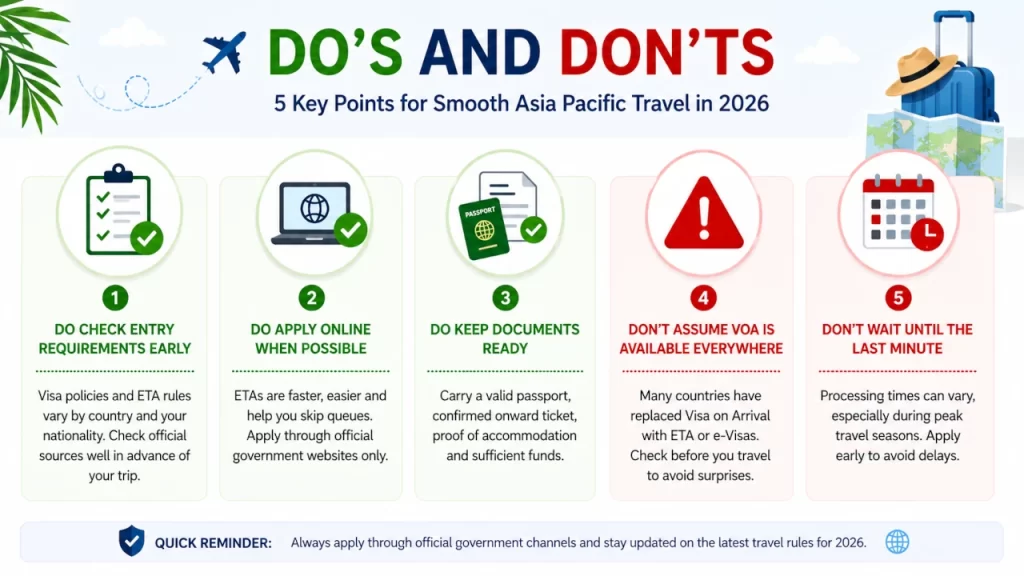
Do’s, Don’ts & Pro Tips When Applying for a Visa to Asia Pacific Countries
✅ Do’s — What You Must Do
- Do check passport validity: Most Asia Pacific countries require at least 6 months of passport validity beyond your intended departure date. Check this before booking flights.
- Do apply on official government portals only: Avoid third-party websites that charge extra fees and may steal your data. Always verify the URL (look for .gov.XX domains).
- Do print your ETA/e-Visa confirmation: Even though it’s electronic, carry a printed copy. Immigration officers occasionally request it, and airline check-in staff may ask to see it.
- Do have USD cash ready for VOA countries: Many VOA counters in Southeast Asia accept US dollars even if local currency is preferred. Small denominations (USD $10–$20 bills) are ideal.
- Do book accommodation before applying: Your hotel or resort booking confirmation is required for both VOA and ETA applications as proof of purpose and accommodation.
- Do check re-entry rules: If your trip involves multiple countries or border crossings, understand whether your visa allows re-entry.
- Do arrive early at the airport on the day of VOA: VOA queues can be long. Arriving 3+ hours before your return flight is recommended in peak season.
❌ Don’ts — What to Avoid
- Don’t use unofficial or third-party visa websites: Sites like “e-visa-india.com” or “cambodia-visa-online.com” are not official. They often charge 2–3x the real fee. Bookmark official .gov sites.
- Don’t wait until the last minute for ETAs: While many ETAs are fast, system overloads, public holidays, and document issues can delay approval. Never apply the night before travel.
- Don’t forget passport photos: VOA counters typically require 1–2 passport-size photos (35mm x 45mm, white background). Forgetting can mean buying overpriced ones at the airport.
- Don’t exceed your allowed stay: Overstaying a visa in countries like Indonesia, Thailand, or Australia carries serious penalties including fines, deportation, and bans on future entry.
- Don’t carry damaged or water-damaged passports: Airlines and immigration may refuse entry. Renew your passport well before travel if it shows visible damage.
- Don’t list a hotel address and then stay elsewhere: This can create complications if immigration cross-checks accommodation, particularly in countries like Japan and Australia.
🍼 Special Guidelines for Travelers with Infants
Traveling with a baby to Asia Pacific is absolutely doable — millions of families do it every year. But there are extra steps that can make all the difference:
- Every infant needs their own visa/ETA: Even a newborn needs a separate ETA or VOA stamp. Don’t assume babies travel under a parent’s visa — this has caused families to be turned away at immigration.
- Get the infant’s birth certificate translated if needed: Some countries (India, Japan) may request a birth certificate for infants without prior travel history. Carry a certified copy.
- Book bassinet seats in advance: Bulkhead or bassinet seats on long-haul flights are limited. Book as early as possible, especially for overnight flights to Australia or New Zealand.
- Apply for the infant’s ETA/VOA separately and early: Technical issues with baby passports (worn-out barcodes, new passports with no travel history) can cause ETA approval delays. Apply at least 3 weeks before departure for infants.
- Check vaccination requirements: Some Asia Pacific countries require proof of vaccinations (particularly yellow fever if traveling from affected regions). India requires yellow fever vaccination proof. Always check with the destination country’s embassy.
- Pack a complete medical kit: Carry your infant’s regular medicines, fever reducers, oral rehydration sachets, and a doctor’s note in English listing medications. This avoids complications with customs and airport security.
- Use family immigration lanes: Most major airports in Asia Pacific (Changi Singapore, Narita Tokyo, Suvarnabhumi Bangkok) have priority family lanes. Look for family or priority immigration signs — they can save you 30–60 minutes in queues with a baby.
- Keep feeding essentials accessible: Baby formula, breast milk, and baby food in reasonable quantities are generally permitted through airport security — declare them and keep them in your carry-on, not in checked luggage.
Book Your Air Ticket
Official & Authentic Resources for Travelers
Government Visa & Immigration Portals
- 🇦🇺 Australia — Department of Home Affairs
- 🇮🇳 India — e-Visa Official Portal
- 🇱🇰 Sri Lanka — ETA Portal
- 🇰🇭 Cambodia — e-Visa Portal
- 🇳🇿 New Zealand — Immigration New Zealand
- 🇲🇾 Malaysia — Window Malaysia eVISA
- 🇹🇭 Thailand — Immigration Bureau
- 🇮🇩 Indonesia — e-VOA Portal
- 🇲🇻 Maldives — Department of Immigration
- 🇳🇵 Nepal — Department of Immigration
- 🇯🇵 Japan — Ministry of Foreign Affairs Visa Info
- 🇵🇭 Philippines — Bureau of Immigration
Travel Safety & Advisory Resources
- 🌐 US Department of State — Travel Advisories
- 🌐 Australia Smartraveller — Travel Advice
- 🌐 UK Foreign Travel Advice (FCO)
- 🌐 IATA Travel Centre — Visa & Health Requirements
Related Guides on RydeTravel
Planning your Asia Pacific adventure? These guides from RydeTravel will help you travel smarter:
- ✈️ Flight Booking Tips for Indian Travelers (2026): How to Fly Smarter and Cheaper
- 🏨 Sri Lanka Visa Fee for Indians 2026 – Smart, Complete Cost Guide
- 🌴 Ultimate Visa Process for Indians (2026) – Simple Step-by-Step Guide
- 👶 6 Most Popular Destination Wedding Hotels in Bentota Sri Lanka 2026
Frequently Asked Questions (FAQ)
1. What is the main difference between a Visa on Arrival and an Electronic Travel Authorization?
A Visa on Arrival (VOA) is obtained physically at the airport or port of entry when you arrive in the country. It requires cash payment and document submission at the immigration counter. An Electronic Travel Authorization (ETA), on the other hand, is applied for online before your trip and is electronically linked to your passport. You don’t need a physical stamp — immigration can verify it digitally. ETAs are generally more convenient for planned trips, while VOAs work better for spontaneous travel to destinations that allow it.
2. Can I get a Visa on Arrival if I already hold a valid ETA for the same country?
No — if you hold a valid ETA for a country, you should use that ETA for entry. You cannot apply for both simultaneously. ETAs supersede the VOA option where both exist. Some countries like Cambodia offer both an e-Visa (ETA-type) and a VOA, but travelers are expected to use only one. Always check the destination country’s immigration rules to avoid complications at the border.
3. How early should I apply for an ETA before my trip?
As a rule of thumb, apply for your ETA at least 7–14 days before departure. For India’s e-Visa, apply a minimum of 4 days ahead as processing takes 72–96 hours. For Australia and New Zealand, while approval can be near-instant, apply 2 weeks early to buffer for any system issues. Never apply the night before your flight — unexpected delays in approval could leave you grounded.
4. Do infants and babies need their own Visa on Arrival or ETA?
Yes, absolutely. Every traveler — including newborns — needs their own valid travel authorization. An infant must have their own passport and their own ETA or VOA. Many families are surprised by this requirement and face stressful situations at immigration. Apply for your infant’s travel documents at the same time you apply for your own, and make sure the infant’s passport photo meets the destination country’s requirements (many require the infant’s eyes to be open and face fully visible).
5. Is it safe to apply for an ETA through a third-party website?
It is strongly recommended to avoid third-party websites for ETA and visa applications. Official government portals are the only guaranteed legitimate source. Third-party sites often charge significantly more than the official fee (sometimes 3–5x the actual cost), and some are outright scams that collect your personal data without submitting a real application. Always verify the URL — official portals will have government domain extensions (e.g., .gov.lk, .gov.kh, .gov.au). When in doubt, contact the country’s embassy directly for the correct portal link.
6. What happens if my ETA is denied? Can I still get a Visa on Arrival?
An ETA denial is a serious matter and typically cannot be circumvented by applying for a Visa on Arrival instead. Most countries that have ETAs do not also offer VOAs as an alternative — an ETA denial often reflects an eligibility issue that also bars VOA entry. In countries like Cambodia or Indonesia where both options exist independently, an ETA denial may not automatically bar VOA eligibility — but consult the country’s embassy first before traveling. For ETA denials in Australia or New Zealand, you’ll need to apply for a full visa through the embassy.
7. Can business travelers use an ETA or VOA for attending meetings and conferences?
Yes — in most Asia Pacific countries, ETAs and VOAs cover short-term business activities such as attending meetings, conferences, trade fairs, product launches, and negotiations. What they do NOT cover is taking up employment, receiving a salary, or performing work on behalf of a local company. If your business travel involves activities beyond meetings — such as setting up operations, signing contracts on behalf of a local entity, or doing paid work — you may need a business visa or work permit. Always review the specific work entitlements listed in each country’s visa category before travel.
8. What documents should I always carry when traveling on a VOA or ETA to Asia Pacific?
Regardless of your visa type, always travel with these essential documents: (1) a valid passport with at least 6 months validity and at least 2 blank pages; (2) your ETA approval email (printed and digital copy); (3) confirmed return or onward travel tickets; (4) confirmed accommodation booking (hotel, resort, or Airbnb confirmation); (5) proof of sufficient funds (bank statement or cash); (6) travel insurance documents; (7) passport-size photos (2–4 copies for VOA countries); and (8) for families with infants — birth certificates and vaccination records. Keeping digital copies in a secure cloud folder (Google Drive, Dropbox) is a smart backup strategy in case physical documents are lost.
Visit our other blogs
Sri Lanka Visa for Indians 2026 – ETA Cost & Full Guide
Ultimate Visa Process for Indians (2026) – Simple Step-by-Step Guide
eSIM Unleashed: Best Global Travel Plans for 2026
Last updated: 2026. Visa rules, fees, and processes change frequently. Always verify current requirements with the official government immigration portal of your destination country before booking travel. RydeTravel is not a visa agency and this content is for informational purposes only.





Leave a Reply