This guide contains affiliate links. We may earn a commission at no extra cost to you — see our Affiliate Disclosure and Affiliate Disclosure Policy for details.
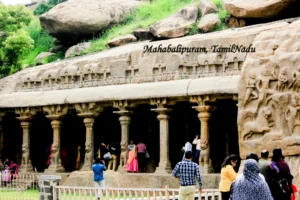
Quick Take: Mahabalipuram is a UNESCO World Heritage coastal town 55 km south of Chennai, best explored over two days with a sunrise visit to the Shore Temple and a single ₹35 ASI ticket covering all major rock-cut monuments.
Key Highlights:
- One ASI ticket (₹35 for Indians, ₹550 for foreigners, free under 15) covers the Shore Temple, Pancha Rathas, Arjuna’s Penance, and all cave temples — book online at asi.payumoney.com/quick/mam and arrive by 6:00 AM to beat the heat and crowds.
- Visit between November and February for pleasant 22–30°C weather; avoid April–June when coastal heat exceeds 38–40°C, and try to catch the January Mahabalipuram Dance Festival for an illuminated Shore Temple backdrop.
- Insider tip: Don’t skip Tiger Cave, 4 km north of town — it has a separate entry fee, stays crowd-free, and its eleven carved tiger heads make it one of the most overlooked highlights of the trip.
To book your stay, click here. To Book Local Travel, click here
Traveling Overseas click here to buy a eSIM. For more info click here
Table of Contents
Places to See in Mahabalipuram: A Ryde Foundation Team Vacation Story
By the Team at Ryde Foundation | Travel & Heritage | Updated: May 2026
I still remember the morning we packed into two cars and left the city noise behind. The whole Ryde Foundation team — the designers, the writers, the strategists, all of us — headed south along the East Coast Road with one goal: a proper vacation. Mahabalipuram was our destination. And I can tell you right now, it exceeded every expectation we carried with us.
At Ryde Foundation, we work hard together every day. So when our team finally decided to take a break together, we wanted somewhere that offered more than just a beach. We wanted history, beauty, and the kind of stillness that resets your mind. Mahabalipuram — also known as Mamallapuram — gave us all of that and more. I am writing this blog to share every place we visited, every feeling we carried home, and every practical detail you need if you plan to make this trip yourself.
Why the Ryde Foundation Team Chose Mahabalipuram
Our team debated several destinations. Someone suggested Ooty, another pushed for Pondicherry. But Mahabalipuram won the vote — and for good reason. It sits just 55 kilometres south of Chennai along the scenic East Coast Road. It carries UNESCO World Heritage status. It offers beaches, temples, rock carvings, fresh seafood, and the kind of open-air atmosphere that makes you forget your inbox exists. We planned a two-day trip, and I promise you, two days felt both too short and absolutely complete.
| Quick Travel Details | Information |
|---|---|
| 📍 Location | Chengalpattu District, Tamil Nadu, India |
| 🚗 Distance from Chennai | ~55 km via East Coast Road (ECR) |
| ⏱️ Travel Time | 1 to 1.5 hours by road |
| 🏛️ UNESCO Status | World Heritage Site (since 1984) |
| 🕕 Monument Timings | 6:00 AM – 6:00 PM (daily) |
| 🎟️ Entry Fee (Indians) | ₹35 per adult (covers all ASI sites) |
| 🎟️ Entry Fee (Foreigners) | ₹550 per adult |
| 👶 Children Under 15 | Free entry |
| 📅 Best Season | November to February |
| 🎫 Online Booking | asi.payumoney.com/quick/mam |
Getting There: Our Drive Down the East Coast Road
We started early — 5:30 AM, to be precise. The ECR stretch from Chennai to Mahabalipuram is genuinely one of the most beautiful drives in Tamil Nadu. The road hugs the coastline, and you spot the Bay of Bengal peeking between the casuarina trees every few kilometres. We stopped briefly at Muttukadu to watch the backwater boats glide across the lagoon. By the time we reached Mahabalipuram, the sunrise had already painted the Shore Temple in shades of gold. That first sight made every sleepy eye on the team instantly wide awake.
Book Your Tour Package
If you travel from Chennai, you reach Mahabalipuram in about 1 to 1.5 hours by road. Government TNSTC buses operate regular services from the Chennai Mofussil Bus Terminus (CMBT). The nearest railway station is Chengalpattu, about 29 kilometres away. For our group, hiring two cabs worked perfectly — comfortable, direct, and we stopped wherever we wanted along the ECR.
Places to See in Mahabalipuram — Our Team’s Personal Journey
1. Shore Temple — Where the Sea Meets a Thousand Years of History
We arrive at the Shore Temple at exactly 6:05 AM, just minutes after it opens. The ticket counter is quiet, the mist still hangs over the ocean, and the granite tower rises against a pale orange sky. Everyone on our team goes silent. That silence says everything.
The Shore Temple dates to the 8th century, built under King Narasimhavarman II of the Pallava dynasty between 700 and 728 CE. It stands as one of India’s oldest structural stone temples, dedicated to both Lord Shiva and Lord Vishnu. Pallava architects built it directly on the shore of the Bay of Bengal — a bold statement about their mastery of both engineering and devotion. The UNESCO World Heritage Committee recognised the entire Group of Monuments at Mahabalipuram in 1984, preserving this extraordinary site for the world.
Book Your Tour Package to Mahabalipuram
We spend almost 45 minutes here. Our team photographer captures the temple with the waves crashing in the background. One of our colleagues, who rarely shows emotion, tells me quietly: “This is the most beautiful thing I have ever seen in Tamil Nadu.” I agree completely.
Go at sunrise. The Shore Temple at 6:00 AM feels like the whole world belongs only to you and a thousand years of Pallava craftsmanship.— Ryde Foundation Team, Mahabalipuram Trip 2026
2. Pancha Rathas — Five Masterpieces Carved from a Single Rock Each
After the Shore Temple, we walk to the Pancha Rathas complex, which our same ASI ticket covers. The moment we see these five monolithic temples rising from the ground, our whole group stops and stares.
Pallava sculptors in the 7th century carve each of these temples from a single granite boulder — not assembled from cut stones, but sculpted downward from the top of a raw rock. The result is five distinct temples, each named after a character from the Mahabharata: Dharmaraja, Bhima, Arjuna, Draupadi, and Nakula-Sahadeva.
What strikes our team most is that these temples are never finished and never used for worship. Historians believe the Pallava sculptors use them as architectural experiments — testing forms, proportions, and styles. That makes them even more fascinating. You also find a life-size carved elephant and a superb stone lion at the complex. Our team spends nearly an hour here, circling every ratha, reading the carved figures, and taking way too many photographs.
3. Arjuna’s Penance — A Story Carved Across an Entire Rock Face
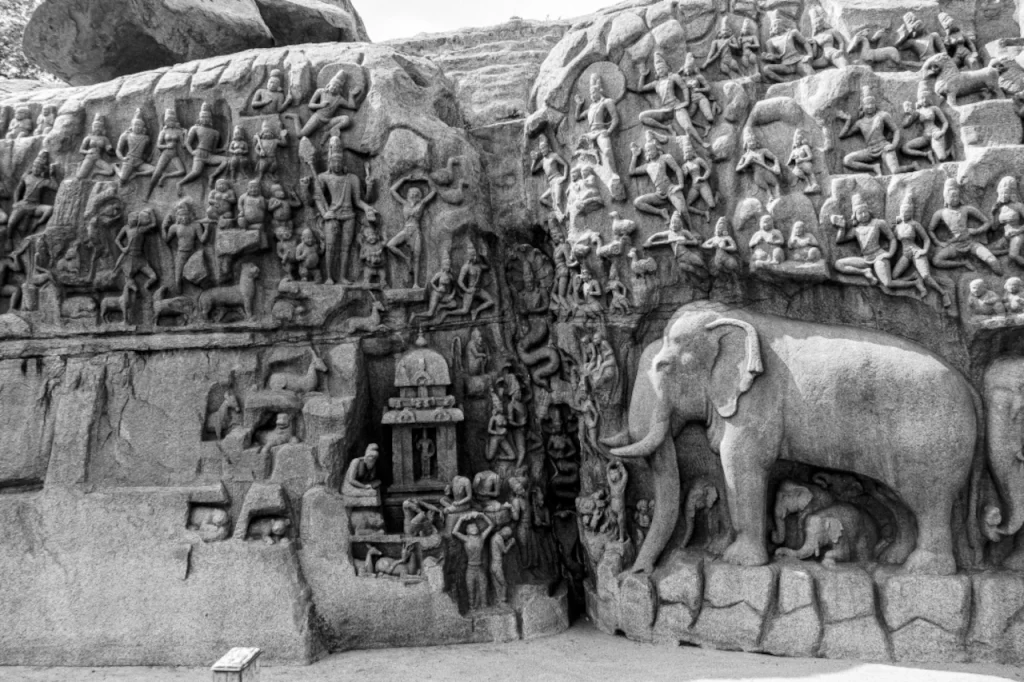
Nothing prepares you for Arjuna’s Penance. We turn a corner and suddenly face a rock face roughly 27 metres wide and 9 metres tall, every centimetre of it carved with figures — gods, humans, animals, serpents, sages, and celestial beings — all flowing toward a natural vertical cleft in the rock through which water once streamed. The scale is staggering. The detail is extraordinary.
Book Your Air Ticket to Chennai
Scholars debate whether the relief depicts Arjuna performing penance to receive the divine weapon Pashupatastra from Lord Shiva, or Bhagiratha praying for the descent of the Ganges from heaven. Either way, Pallava artists create one of the largest open-air bas-relief carvings on earth here, and they do it with a naturalism and storytelling depth that modern artists still admire.
Our team stands here for a long time. Some colleagues walk along the length of the relief identifying animals and figures. Someone spots a cat performing its own version of penance — a famous carved detail hidden in the narrative. When you find that cat carving, you feel like you have discovered a secret. We all laugh and point it out to each other.
4. Krishna’s Butter Ball — The Rock That Defies Science and Everyone Who Tried to Move It
Just a short walk from Arjuna’s Penance, we find Krishna’s Butter Ball — a massive granite boulder roughly 6 metres high, 5 metres wide, and weighing over 250 tonnes, sitting on a tiny patch of sloping rock. It looks like it should slide off. It should not be there. But it sits exactly where it has sat for approximately 1,200 years, completely immovable.
The Pallava king Narasimhavarman I reportedly sends seven elephants to push it away. They fail. Modern geologists scratch their heads at its stability. Local legends link it to Lord Krishna, saying it is a ball of butter he drops from the heavens. Whatever the explanation, it is one of the most genuinely surprising natural spectacles our team encounters on this trip. Everyone tries to push it. No one moves it even slightly. We all laugh about it over lunch later.
5. The Cave Temples — Pallava Art at Its Most Intimate
Mahabalipuram’s cave temples (mandapams) rank among the finest rock-cut architecture in all of India. Our team visits four of them on our first day, and each one feels completely different from the last.
- Varaha Cave Temple — We step inside and find a magnificent carving of Lord Vishnu in his Varaha avatar — the cosmic boar lifting Mother Earth (Bhudevi) from the primordial ocean. The detail in Bhudevi’s expression alone takes your breath away. Pallava sculptors carve this during the reign of Narasimhavarman I in the 7th century, and the artistry feels astonishingly modern.
- Mahishasura Mardini Cave — Two large relief panels dominate the walls. On one side, Goddess Durga rides her lion and battles the buffalo demon Mahishasura with fierce grace. On the other side, Lord Vishnu reclines peacefully on the serpent Adisesha. The contrast between power and serenity in a single cave is something our whole team talks about that evening.
- Krishna Cave Temple — This open-air cave depicts the beloved story of Lord Krishna lifting Mount Govardhan to shelter villagers from Indra’s furious rains. The villagers, the cows, the cowherd women — every figure carries a sense of movement and life.
- Trimurti Cave — Dedicated to the Hindu Trinity of Brahma, Vishnu, and Shiva, this cave is uniquely designed without a pillared entrance. It opens directly to three separate shrines. A small shrine to Goddess Durga occupies a corner. We find this cave the most peaceful and meditative of all.
6. Tiger Cave — The Hidden Gem That Most Visitors Miss
On our second morning, we drive four kilometres north of town to visit the Tiger Cave — and I am so glad we do. Most visitors stick to the main monument complex and skip this entirely. We find it completely quiet, surrounded by trees, with a small stream nearby. The cave is an 8th-century rock-cut shrine dedicated to Goddess Durga, and what makes it unforgettable is the entrance: eleven intricately carved tiger heads frame the archway around the sanctum.
Note that the Tiger Cave has a separate entry fee from the main ASI complex. But the peaceful atmosphere, the extraordinary carvings, and the near-total absence of crowds make it genuinely worth the extra stop. Our team sits on the rocks nearby and eats the breakfast we pack — vadai, idli, and filter coffee from a roadside stall — with the Bay of Bengal glittering just beyond the trees. One of the best mornings of the trip.
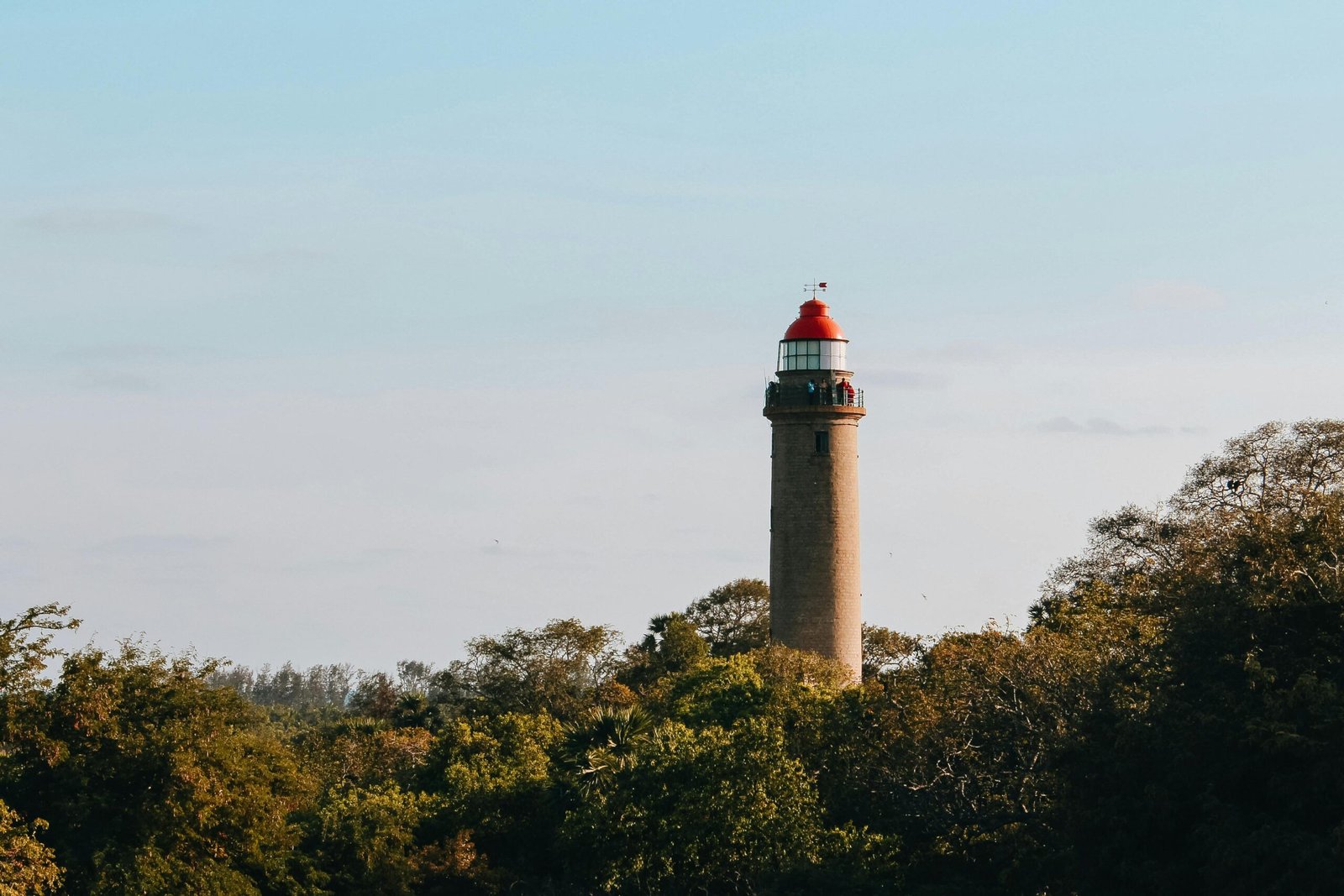
7. Mahabalipuram Lighthouse — The Best View in Town
The Mamallapuram Lighthouse has been guiding ships since 1904 and welcomes public visitors since 2011. We climb to the top and suddenly see everything — the entire monument complex laid out below us, the coastline curving north and south, the fishing boats far out on the Bay of Bengal, and the town’s stone-carving workshops sending up faint sounds of chisel on granite. Right beside the working lighthouse stands the Olakkannesvara Temple, an 8th-century structural temple also used as a lighthouse by the Pallavas. Ancient and modern, side by side on the same hillock. Our team finds this detail genuinely charming.
8. Mahabalipuram Beach — Where We Finally Slow Down
By late afternoon on our first day, our team finds its way to Mamallapuram Beach — and we simply stop moving for a while. The beach runs right through the heart of town. Stone-carving stalls line the road behind it. Rooftop restaurants offer grilled fish and cold drinks. The backpacker community gives the beach a relaxed international energy. The sea breeze after a full day of monument walking feels like the best reward imaginable.
We eat dinner at a rooftop restaurant overlooking the water — freshly grilled pomfret, prawn masala, rice, and rasam. The food costs almost nothing. The view is priceless. We stay until the stars come out and the Shore Temple glows under floodlights in the distance. This is the evening none of us will forget.
9. The Stone Carving Workshops — A Living 1,300-Year Tradition
Mahabalipuram carries a living tradition of stone sculpture that stretches back over 1,300 years, and you can watch it happen on the main street running through town. Artisans sit cross-legged on the roadside, tapping and chiselling granite into deities, busts, decorative panels, and miniature temples. The sound of chisel on stone fills the whole town with a rhythmic, meditative music. Our design team members are completely transfixed. We spend an hour walking through the workshops, talking to craftsmen, and admiring pieces at various stages of completion. Several of us buy small carved pieces directly from the artisans to bring home.
10. India Seashell Museum — Surprisingly Wonderful
We almost skip the India Seashell Museum, assuming it is just a tourist novelty. We are completely wrong. The museum houses over 40,000 specimens of rare seashells, shark teeth, whale fins, fossils, pearls, and minerals, making it the largest collection of its kind in Asia. An attached aquarium displays live sea creatures. For the science-minded members of our team, this turns into one of the most engrossing stops of the entire trip. Even those who come in sceptically leave genuinely impressed. It is a perfect indoor break from the afternoon heat.
What Our Ryde Foundation Team Ate in Mahabalipuram
Food deserves its own mention. Mahabalipuram is a seafood lover’s paradise. We eat idli and vadai from a roadside cart before monuments open. We grab fresh coconut water every hour. For lunch, we find a small family-run restaurant near the bus stand serving a proper Tamil Nadu meals — rice, sambar, rasam, three curries, and papad — for under ₹120 per person. For dinner both evenings, we choose rooftop restaurants near the beach and eat grilled fish, butter garlic prawns, and prawn biryani. Every meal is fresh, flavourful, and unreasonably affordable. Our team rates the food as one of the top highlights of the trip.
Practical Tips from Our Team’s Experience
- Start at 6:00 AM sharp — The Shore Temple and Arjuna’s Penance at sunrise are magical experiences. Heat and crowds build quickly after 9:00 AM.
- Book ASI tickets online before you arrive at asi.payumoney.com/quick/mam — one ticket covers all Group of Monuments sites. Keep it safe; you show it at every monument entrance.
- Wear walking shoes — The monument complex involves extensive walking on uneven granite surfaces. Sandals work in a pinch but proper shoes are far more comfortable.
- Carry water and sunscreen — The open coastal sites offer almost no shade. We go through two litres of water per person each morning.
- Hire a local guide — Licensed guides at the ticket counter dramatically enrich your understanding of the carvings, mythology, and history. Agree on fees beforehand; expect around ₹300–₹500 for a group tour of the main complex.
- Don’t skip Tiger Cave — Add the extra 10-minute drive north. The quiet, the carvings, and the absence of crowds make it absolutely worth it.
- Spend two days — One day covers the main monuments. Two days lets you breathe, explore the beach, visit Tiger Cave, try the Seashell Museum, and eat properly.
- Go between November and February — The weather is genuinely pleasant. We visit in January and it is ideal — cool breezes, clear skies, perfect for walking and photography.
Official & Authentic Resources for Planning Your Visit
Always verify current timings, fees, and facilities through these official sources before you travel:
- 🏛️ ASI Online Ticket Booking — Group of Monuments, Mahabalipuram
https://asi.payumoney.com/quick/mam - 🌿 Tamil Nadu Tourism — Official Mamallapuram Page
https://www.tamilnadutourism.tn.gov.in/destinations/mamallapuram - 📄 Tamil Nadu Tourism — Official Mamallapuram Brochure (PDF)
https://www.tamilnadutourism.tn.gov.in/img/ebrochure/mamallapuram.pdf - 🌍 UNESCO World Heritage — Group of Monuments at Mahabalipuram
https://whc.unesco.org/en/list/249 - 🏛️ Archaeological Survey of India (ASI) — Official Website
https://asi.nic.in - 🗺️ Incredible India — Tamil Nadu Destinations
https://www.incredibleindia.gov.in/en/destinations/destinations-by-state/tamil-nadu - 🐊 Madras Crocodile Bank Trust (14 km north of Mahabalipuram)
https://madrascrocodilebank.org
Book Your Local Travel
Frequently Asked Questions About Mahabalipuram
1. What makes Mahabalipuram different from other heritage sites in Tamil Nadu?
Mahabalipuram stands apart because it combines heritage, coastline, and living craft tradition in one place. While other Tamil Nadu heritage towns focus purely on temple architecture, Mahabalipuram gives you UNESCO-listed open-air rock-cut monuments, a functioning beach town, centuries-old stone-carving workshops that still operate today, and a relaxed coastal atmosphere — all within a compact walkable area. The Shore Temple’s location directly on the Bay of Bengal also gives it a visual drama that no inland heritage site in Tamil Nadu can match. The entire experience feels like walking through a working outdoor museum with the ocean as its backdrop.
2. How do I reach Mahabalipuram from Chennai?
You reach Mahabalipuram most comfortably by road. The town sits 55 kilometres south of Chennai along the East Coast Road (ECR / State Highway 49), and the drive takes between 1 and 1.5 hours depending on traffic. TNSTC government buses operate frequent services from the Chennai Mofussil Bus Terminus (CMBT) at Koyambedu. If you prefer rail, travel to Chengalpattu Station (29 km from Mahabalipuram) and take a bus or cab from there. Hiring a cab or an auto-rickshaw from Chennai gives you the most flexibility, especially if you want to stop at Muttukadu Boathouse or the Crocodile Bank along the ECR on the way.
3. Is one ASI ticket enough for all monuments in Mahabalipuram?
Yes — one ASI ticket covers all the major Group of Monuments sites managed by the Archaeological Survey of India, including the Shore Temple, Pancha Rathas, Arjuna’s Penance, all the cave temples, and Krishna’s Butter Ball. Entry costs ₹35 for Indian nationals, ₹550 for foreign nationals, and children under 15 enter free. Keep your ticket safely with you throughout the visit, as ASI staff check it at every monument entrance. The Tiger Cave, located 4 km north of town, has a separate modest entry fee and is not part of the main ASI complex ticket. You can book online at asi.payumoney.com/quick/mam.
4. Is Mahabalipuram suitable for a team or group outing?
Absolutely — we speak from direct experience. Mahabalipuram works beautifully as a team or group outing because it caters to every personality type. The history lovers in your group explore the monuments for hours. The photographers never run out of subjects. The food enthusiasts work their way through the seafood restaurants. The beach people find their space on the sand. Everyone gathers comfortably in the evenings, and the compact size of the town means the group stays together naturally without anyone feeling lost or bored. Good resort and hotel options are available for overnight stays, and the drive from Chennai along the ECR makes the journey itself an enjoyable group experience.
5. What is the best time to visit Mahabalipuram in 2026?
November to February offers the best conditions for visiting Mahabalipuram. Temperatures during these months range from approximately 22°C to 30°C, sea breezes keep outdoor sightseeing comfortable, and skies stay mostly clear for photography. January is particularly special if you can time your visit to coincide with the Mahabalipuram Dance Festival — an internationally celebrated classical dance event where Bharatanatyam and other traditional forms are performed with the illuminated Shore Temple as the backdrop. Avoid April through June when the coastal heat regularly exceeds 38–40°C, making extended outdoor sightseeing uncomfortable.
6. What should I not miss in Mahabalipuram beyond the main monuments?
Beyond the ASI complex, three things stand out from our team’s experience. First, visit the Tiger Cave — 4 km north of town, peacefully quiet, dramatically carved, and almost always crowd-free. Second, walk through the stone-carving workshops on the main street and spend time watching craftsmen at work. The tradition stretches back over 1,300 years and you can purchase pieces directly from the artisans at fair prices.
Third, stay for dinner on a rooftop restaurant facing the sea — the combination of fresh seafood, sea breeze, and the Shore Temple glowing under lights in the distance creates a memory that stays with you long after the trip ends. The India Seashell Museum and the Madras Crocodile Bank Trust (14 km north on ECR) also both exceed expectations as supplementary visits.
A Note from the Ryde Foundation Team
At Ryde Foundation, we believe that the values we carry — compassion, honesty, respect, integrity, responsibility, fairness — shape not just how we work but how we travel. Mahabalipuram taught our team something quietly important: that people who lived 1,300 years ago also cared deeply about beauty, craft, devotion, and legacy. They carved their values into granite. They built temples to outlast empires. Standing in front of those monuments, our whole team feels both humbled and inspired.
If you work in a team and you want a trip that bonds people through shared wonder rather than organised activities, take your team to Mahabalipuram. Let the Shore Temple do the rest.
We share more travel stories, learning journeys, and team experiences on the Ryde Foundation news blog. Come visit us there.
Published by the Ryde Foundation Team | May 2026 | Sources: Archaeological Survey of India · Tamil Nadu Tourism · UNESCO World Heritage List · Ryde Foundation Team Visit, January 2026. Entry fees, timings, and facilities are subject to change — verify with official sources before visiting.
visit our other blogs
Perfect Kanyakumari Tourism Guide 2026 – Top Spots & Smart Travel Tips




Leave a Reply