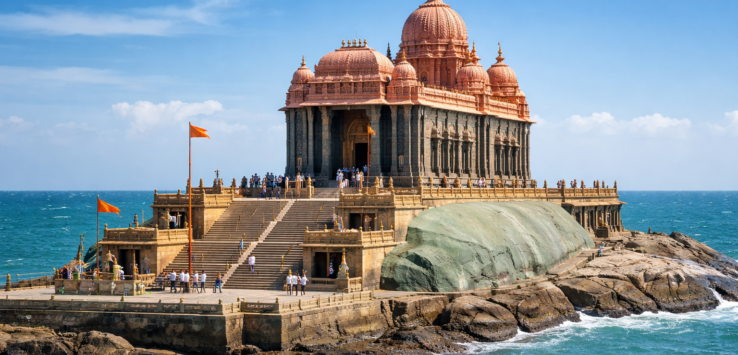
Kanyakumari stands at the very tip of India’s mainland — the point where the Arabian Sea, the Bay of Bengal, and the Indian Ocean converge in a dramatic meeting of waters. Pilgrims, history enthusiasts, nature lovers, and wanderers from across the globe travel to this coastal town for one reason: nowhere else on earth offers this extraordinary blend of spiritual energy, geological wonder, and cultural depth in a single destination. This guide gives you everything you need to plan a memorable trip to Kanyakumari in 2026.
📍 About Kanyakumari — India’s Land’s End
Kanyakumari (also spelled Kanniyakumari) occupies a unique geographical position as the southernmost tip of the Indian subcontinent. The British called it Cape Comorin — a name derived from the Devi Kanya Kumari, the Virgin Goddess, to whom this land is consecrated. The town was historically part of the Travancore kingdom in Kerala before the Indian States Reorganization Act of 1956 merged it into Tamil Nadu.
Today, Kanyakumari District encompasses four taluks — Agasteeswaram, Thovalai, Kalkulam, and Vilavankode — each carrying its own cluster of temples, forts, beaches, and natural wonders. The Western Ghats, featuring peaks like Mahendragiri and Agasthiyarkudam, backdrop the entire district and add forest trails, waterfalls, and biodiversity to a destination most people associate with the sea alone.
“At Kanyakumari, you can witness the sun rise and set over the same ocean — a sight that moves every visitor, no matter how many times they’ve seen it.”
🗓️ Best Time to Visit Kanyakumari
❄️ Winter (Nov – Feb) — Best Season
Temperatures drop to a comfortable 17°C–25°C. The sea breeze keeps conditions cool and fresh. Visibility is excellent for sunrise and sunset views. This period attracts the highest tourist footfall, so book hotels in advance.
☀️ Summer (Mar – Jun) — Manageable
Temperatures climb to 35°C–38°C but the coastal winds moderate the heat. Evenings remain pleasant. Mango showers offer brief relief. Crowds thin out, giving you more space at popular spots.
🌧️ Monsoon (Jul – Sep) — For Adventurers
Southwest monsoons bring heavy rainfall. The three-ocean confluence looks dramatic and raw in the rain. Low-lying areas may flood. Carry rain gear and check weather forecasts before coastal activities.
✈️ How to Reach Kanyakumari
🛫 By Air
Kanyakumari has no airport of its own. The nearest international and domestic airport is Trivandrum International Airport (TRV), located approximately 81 km away. From Trivandrum, travellers take a taxi (around ₹1,200–₹1,800) or a KSRTC/TNSTC bus to Kanyakumari in about 90 minutes. Alternatively, Tuticorin (Thoothukudi) Airport lies around 100 km to the north and handles IndiGo and SpiceJet domestic routes.
🔗 Official Airport Site: Trivandrum International Airport
🚆 By Train — Most Recommended
Kanyakumari Railway Station connects directly to Chennai, Mumbai, Delhi, Kolkata, Bangalore, and Coimbatore. The Vivek Express (Train No. 15906) holds the record as India’s longest rail journey and terminates here. The scenic route through the Western Ghats makes the train journey a highlight in itself. From Trivandrum Pettah Railway Station, short trains run to Kanyakumari in under 2 hours.
🔗 Book tickets: Indian Railway Catering and Tourism Corporation (IRCTC)
🚌 By Bus
TNSTC (Tamil Nadu State Transport Corporation) and KSRTC operate direct buses from Chennai, Coimbatore, Madurai, Trichy, Thiruvananthapuram, and Trivandrum to Kanyakumari. Private sleeper buses from Bengaluru and Chennai run overnight. The bus stand sits just 1 km from the famous Triveni Sangam viewpoint.
🔗 Official Bus Booking: Tamil Nadu State Transport Corporation (TNSTC)
🚗 By Road — Self Drive
NH 44 (formerly NH 7) connects Kanyakumari to Varanasi, making it part of India’s longest national highway. Bikers and road trippers frequently complete the classic Kashmir to Kanyakumari road journey that ends right here. From Madurai it is about 250 km and from Chennai approximately 700 km. Roads are well-maintained throughout Tamil Nadu.
🚌 Local Travel Within Kanyakumari
Getting around Kanyakumari is easy and affordable. Here are the main local transport options:
| Transport Mode | Route / Use | Approx. Fare | Availability |
|---|---|---|---|
| 🛺 Auto Rickshaw | Town centre to all major attractions | ₹40–₹150 per trip | Available 6 AM – 10 PM |
| 🚌 Town Bus (TNSTC) | Bus Stand to Triveni Sangam (Tip Point) | ₹7–₹15 | Frequent; every 10–15 mins |
| 🚕 Cab / Taxi | Half-day / Full-day sightseeing | ₹800–₹1,600 per day | Available via Ola, local stands |
| ⛵ Ferry Boat | Shore → Vivekananda Rock Memorial & Thiruvalluvar Statue | ₹100 (round trip) | 8 AM – 4 PM (weather permitting) |
| 🚲 Bicycle Rental | Coastal cycling; Sothavilai Beach area | ₹50–₹100 per hour | Available near beach areas |
💡 Local Tip: Town buses charge just ₹15 from the main bus stand to Triveni Sangam (Tip Point). Auto drivers often quote inflated rates for tourists — always agree on the fare before boarding. Hire a full-day cab if you plan to visit Vattakottai Fort, Thirparappu Falls, and Mathur Aqueduct in one day.
🏛️ Top Places to Visit in Kanyakumari
1. Vivekananda Rock Memorial
The Vivekananda Rock Memorial rises from a small island rock about 500 metres offshore in the Laccadive Sea. Built in 1970 to honour Swami Vivekananda, who is believed to have attained enlightenment on this rock in 1892, the memorial covers an area of six acres and sits 17 metres above sea level. Visitors reach the island by a short ferry ride (₹100 round trip) that operates from 8 AM to 4 PM. The architectural style blends elements from all major Indian temple traditions. Inside the Dhyana Mandapam (meditation hall), a profound stillness descends over visitors surrounded by the roaring ocean on all sides.
🔗 Official Info: Vivekananda Kendra – Rock Memorial
2. Thiruvalluvar Statue
The Thiruvalluvar Statue soars 40.89 metres (133 feet) from its island rock pedestal right beside the Vivekananda Rock Memorial. Constructed in Dravidian architectural style, the statue depicts the revered Tamil poet and philosopher Thiruvalluvar, author of the Thirukkural. The 133-feet height symbolises the 133 chapters of the Thirukkural. The same ferry service that serves the Vivekananda Rock Memorial takes you to the statue’s base, where you can walk up the plinth for close-up views. The sight of both the statue and the memorial against the three-ocean horizon is Kanyakumari’s defining visual.
3. Kumari Amman Temple (Kanyakumari Temple)
Perched right at the sea’s edge, the Kumari Amman Temple consecrates one of the 108 Shakti Peethas of India. Devotees believe this ancient temple honours Goddess Devi Kanya Kumari — the Virgin Goddess and sister of Lord Krishna — who performed penance at this very spot to marry Lord Shiva. The diamond nose ring (Navaratna) of the deity is so luminous that sailors historically used it as a lighthouse marker. The temple follows strict dress codes (men must enter shirtless; women in traditional attire). Non-Hindus may view from designated areas. Manage your visit before sunrise or after sunset for a deeply spiritual atmosphere.
🔗 Official: Tamil Nadu Tourism – Kanyakumari
4. Gandhi Memorial Mandapam
The Gandhi Memorial Mandapam marks the hallowed spot where the ashes of Mahatma Gandhi rested before their immersion in the sea. Architects designed this monument with a deliberate celestial precision: on Gandhi’s birth anniversary, October 2nd, sunlight passes through an opening in the roof and illuminates the exact spot where his urn stood. The structure blends Kalinga and Dravidian architectural elements and stands close to the seashore, with waves crashing audibly on all sides. The memorial is free to enter and stays open daily from 7 AM to 7 PM.
5. Triveni Sangam — The Three-Ocean Confluence (Tip Point)
Triveni Sangam is the geographic heart of Kanyakumari — the actual tip where the turquoise waters of the Bay of Bengal, the deep blue of the Indian Ocean, and the sea-green of the Arabian Sea converge. On a clear day, you can observe three visually distinct bands of colour in the water. The View Tower nearby offers a panoramic vantage point. Arrive at dawn to witness the sun rising over the confluence, a moment that feels genuinely world-historic. Buses from the station cost ₹7–₹15 to this point.
6. Vattakottai Fort
The Vattakottai Fort — meaning “Circular Fort” — stands 12 km from Kanyakumari town, where the Thamirabarani River meets the sea. The Archaeological Survey of India maintains this 18th-century granite structure that the erstwhile Travancore kingdom built to defend against Dutch and British naval attacks. Sections of the fort extend directly into the sea. The fort offers spectacular views of the sea on one side and the Western Ghats on the other — an unforgettable dual panorama. Entry fees apply separately for the fort and the adjacent beach. Hire a taxi or take a TNSTC bus from the main bus stand.
7. Suchindram Thanumalayan Temple
The Thanumalayan Temple (Sthanumalayan Koil) stands 13 km from Kanyakumari in the town of Suchindram. This living temple consecrates the Hindu Trinity — Brahma, Vishnu, and Shiva — under a single roof and in a single deity form, a theological concept unique in India. The temple features exquisitely carved gopurams (tower gateways), musical pillars that produce seven distinct musical notes when struck, and a 22-foot Hanuman idol. Devotees and architecture enthusiasts travel here specifically to study its Dravidian craftmanship. The temple management operates free buses on festival days.
8. Thirparappu Waterfalls
About 55 km from Kanyakumari, the Thirparappu Falls cascades 50 feet over a wide rocky ledge into a scenic pool below. Although a manmade dam structure controls the water flow, the surrounding thick green foliage and indigenous fauna make the site feel entirely natural. The cool pool below the falls attracts families for a refreshing splash. A small Shiva temple dedicated to Lord Bhuthanathan sits right by the falls. Visit in the morning for fewer crowds. Local minibuses connect Nagercoil (the district hub) to the falls area.
9. Mathur Aqueduct (Mathur Hanging Bridge)
The Mathur Aqueduct is one of the tallest and longest irrigation trough bridges in Asia, spanning the Pahrali River valley. The structure stands 115 feet tall and stretches 1,230 metres in length. Engineers built it in 1966 to carry water to the paddy fields of Kanyakumari district. From the top, the sweeping views of the Western Ghats and lush valleys below are breathtaking. The bridge is open to visitors who walk across for a bird’s-eye perspective of the landscape. Located about 40 km from Kanyakumari town, it pairs well with a trip to Thirparappu Falls.
10. Our Lady of Ransom Church
Built in the 15th century by Portuguese missionaries, the Church of Our Lady of Ransom stands right against the ocean backdrop. The church features stunning Gothic architecture, white spires, stained glass windows, and a gold cross that catches the morning sun. Dedicated to Mother Mary, this church is a working place of worship that welcomes visitors respectfully. It represents the deep Christian heritage of the Kanyakumari coast, where fishing communities have practised Catholicism for over 500 years.
11. Tsunami Memorial Park
The Tsunami Memorial Park honours the victims of the December 2004 Indian Ocean tsunami, which devastated coastal Tamil Nadu. The park’s symbolic structure depicts a massive blue wave being pushed back by one hand while the other hand holds a lamp of hope — a powerful visual tribute to resilience. The memorial stands 1.3 km from the railway station and is free to enter. The park also functions as a quiet seafront garden where visitors reflect on nature’s power and human strength.
12. Sothavilai Beach & Sanguthurai Beach
While the main Kanyakumari Beach buzzes with tourist activity, Sothavilai Beach and Sanguthurai Beach offer quieter, cleaner alternatives just a short distance away. Sothavilai Beach is acclaimed by Tamil Nadu Tourism as one of the finest stretches of coast in the state. Sanguthurai Beach lets you experience the fierce power of the Indian Ocean with far fewer visitors. Both beaches display the famous multicoloured sand of Kanyakumari — a geological curiosity caused by garnet, ilmenite, and other mineral deposits that give the sand red, black, white, and yellow hues.
🔗 Tamil Nadu Tourism Official Site: www.tamilnadutourism.tn.gov.in
🍽️ What to Eat in Kanyakumari
Kanyakumari’s coastal location ensures that fresh seafood dominates the local cuisine. The town’s cuisine reflects a layered cultural identity — Tamil Brahmin vegetarian traditions, coastal fishing community recipes, and Kerala-influenced coconut-heavy curries all coexist on a single street.
- Fish Curry and Rice — The staple meal of the fishing communities; made with freshly caught Seer fish or Kingfish in a coconut-tamarind gravy.
- Puttu and Kadala Curry — A Kerala-influenced breakfast staple of steamed rice cylinders with spiced black chickpeas.
- Kanyakumari Fish Fry — Whole fried Pomfret or Tuna coated in a red chilli-masala crust; sold at shacks near the beach.
- Coconut-Based Curries — Prawn masala, crab curry, and mussel preparations cooked in fresh coconut milk are specialties of the region.
- Kothu Parotta — A street food staple made by chopping flaky layered flatbread with egg, vegetables, or mutton on a hot griddle.
- Filter Coffee — Strong, frothy South Indian filter coffee accompanies every meal; sold from roadside stalls from 5 AM.
💡 Recommended Restaurants: Triveni Sangam Restaurant (pure vegetarian; near Tip Point), Hotel Saravana Bhavan (chain outlet; near bus stand), and local sea-facing shacks near the main beach for freshest catches.
🛍️ Shopping in Kanyakumari
The Evening Market near the Kumari Amman Temple and the shops along the seashore sell the best souvenirs in Kanyakumari. Look for:
- Conch Shells and Sea Shell Crafts — Intricately carved decorative items unique to this coastal market.
- Multicoloured Sand Bottles — Layered bottles filled with the characteristic coloured sands of Kanyakumari beaches — a popular, lightweight souvenir.
- Handloom Fabrics — Traditional cotton and silk textiles from the local weaving communities.
- Spices and Dried Fish — Local red chillies, pepper, cardamom, and dried sea fish make excellent edible gifts.
- Miniature Souvenirs — Replica models and postcards of the Vivekananda Rock Memorial and Thiruvalluvar Statue.
🏨 Where to Stay in Kanyakumari
💎 Premium (₹3,000–₹6,000/night)
Sparsa Resort, Hotel Maadhini (both sea-facing), and Annai Resorts offer excellent facilities, pools, and stunning ocean views. Book 2–3 weeks ahead during peak season (Dec–Jan).
🏨 Mid-Range (₹1,200–₹2,800/night)
Hotel Saravana, Hotel Tamil Nadu (TTDC-run government hotel with sea views), and Sea View Hotel offer clean, comfortable rooms with good value for families and couples.
💰 Budget (₹400–₹1,000/night)
Several Ganga Lodge branches near the ICICI Bank area offer budget-friendly rooms from ₹650 upwards. Pilgrim lodges near the Kumari Amman Temple also provide clean dormitory and private room options.
🔗 Book TTDC accommodations: Tamil Nadu Tourism Development Corporation (TTDC)
💡 Essential Travel Tips for Kanyakumari
- Sunrise Planning: Wake up by 5 AM and head to the seafront near the boating ticket counter for a quieter sunrise experience. The main Sunrise Viewpoint becomes extremely crowded during peak season.
- Temple Dress Code: Carry a dhoti for the Kumari Amman Temple (men enter without shirts). Women wear sarees or salwar kameez. Both genders remove footwear before entering all temples.
- Ferry Timings: The ferry to Vivekananda Rock Memorial operates 8 AM–4 PM. Arrive before 8 AM to queue early and avoid hour-long waits during peak season.
- Local Culture: Kanyakumari hosts traditional art forms like Kalaripayattu (martial art), Villu Paatu (bow song), and Kalial dance. Check with resorts for evening cultural performances.
- Monsoon Safety: Avoid sea-facing activities during July–September. Rip currents and high waves make swimming dangerous. The ferry service suspends operations during rough weather.
- Cash Access: ATMs from SBI, HDFC, and ICICI operate near the beach market and bus stand. Carry sufficient cash as small temple shops and local vendors rarely accept cards.
- Connectivity: Jio, Airtel, and BSNL offer good 4G coverage in the town area. Remote areas like Chitharal and Kalikesam have patchy signal.
🗺️ Suggested 3-Day Kanyakumari Itinerary
Day 1 — Arrival & The Sacred Shoreline
Arrive in the evening and check in to your hotel. Walk to the Triveni Sangam (Tip Point) for your first view of the three-ocean confluence. Watch the sunset from the seafront. Visit the Evening Market for sea shell souvenirs. Dine at a sea-facing restaurant on fresh fish curry and rice.
Day 2 — Sunrise, Rock Memorial & Monuments
Rise at 5 AM for the sunrise near the boating counter area (quieter than the main viewpoint). After sunrise, join the ferry queue for the Vivekananda Rock Memorial and Thiruvalluvar Statue (8 AM onward). Spend 2–3 hours on the islands. After lunch, visit the Gandhi Memorial Mandapam, Kumari Amman Temple, and Our Lady of Ransom Church. End the day at the Tsunami Memorial Park.
Day 3 — Forts, Falls & Aqueducts
Hire a full-day taxi (₹1,200–₹1,600) and cover Vattakottai Fort (12 km), Thirparappu Waterfalls (55 km), and Mathur Aqueduct (40 km) in one loop. Return via Suchindram Thanumalayan Temple (13 km from town) for evening prayers and the musical pillar experience. Depart the next morning.
🔗 Official & Authentic Reference Websites
- 🏛️ Tamil Nadu Tourism (Official): tamilnadutourism.tn.gov.in
- 🏨 TTDC Hotel Bookings: ttdconline.com
- 🚆 Train Bookings (IRCTC): irctc.co.in
- 🚌 Bus Bookings (TNSTC): tnstc.in
- ✈️ Trivandrum Airport: trivandrum-airport.com
- 🧘 Vivekananda Rock Memorial: vivekanandakendra.org
- 📍 Archaeological Survey of India: asi.nic.in
- 🏥 Kanyakumari District Official Portal: kanyakumari.nic.in
❓ Frequently Asked Questions About Kanyakumari
Q1. What makes Kanyakumari unique compared to other Indian tourist destinations?
Kanyakumari is the only place in India where you can watch both the sunrise and sunset over the ocean from the same location. It also marks the geographical point where three major water bodies — the Arabian Sea, Bay of Bengal, and Indian Ocean — converge. This unique combination of spiritual significance (108 Shakti Peethas, Vivekananda’s enlightenment site), natural wonder, colonial history (Cape Comorin), and literary heritage (Thiruvalluvar Statue) makes Kanyakumari unlike any other destination in the country.
Q2. How many days do I need to explore Kanyakumari properly?
Two full days cover all major town attractions, including the Vivekananda Rock Memorial, Thiruvalluvar Statue, Kumari Amman Temple, Gandhi Mandapam, and the beach areas. Add a third day to cover outstation attractions like Vattakottai Fort, Thirparappu Waterfalls, Mathur Aqueduct, and the Suchindram Thanumalayan Temple. If you plan to explore the forests near Agasthiyarkudam or visit Chitharal Jain Monuments, allocate 4–5 days for a thorough experience.
Q3. What is the ferry timing and ticket price for Vivekananda Rock Memorial?
The Tamil Nadu government operates the ferry service from the boating jetty (near Triveni Sangam) to Vivekananda Rock Memorial and Thiruvalluvar Statue between 8 AM and 4 PM daily. The round-trip ticket costs ₹100 per person (subject to revision; check the official site or the jetty notice board on the day of your visit). The service suspends operations during rough sea conditions, especially during the monsoon months (July–September). Arrive early on weekends and during school holidays, as queues can stretch to 1–2 hours.
Q4. Is Kanyakumari safe for solo female travellers?
Yes, Kanyakumari is generally considered safe for solo female travellers, especially during the day. The town is small, well-policed, and bustling with pilgrims and families year-round. Key safety practices include: staying in well-lit and busy accommodation zones near the main beach, avoiding isolated beach stretches after dark, using metered or app-based taxis rather than negotiating with unknown auto drivers at night, and dressing conservatively near temple areas. The Tamil Nadu Tourism Police Helpline is accessible at 1800-425-4747 (toll-free).
Q5. Can non-Hindus enter the Kumari Amman Temple and other temples in Kanyakumari?
Non-Hindus are not permitted to enter the inner sanctum (garbhagriha) of the Kumari Amman Temple. The temple administration designates a viewing area outside the main entrance where non-Hindu visitors can observe the architecture and ceremonies from a respectful distance. The Suchindram Thanumalayan Temple follows similar guidelines. In contrast, the Chitharal Jain Monuments and Our Lady of Ransom Church are open to all visitors regardless of religion. Always check dress code requirements before visiting any religious site — most temples require you to remove footwear and observe modest dress.
Q6. What local cultural experiences can I have in and around Kanyakumari?
Kanyakumari offers rich local cultural experiences beyond its famous monuments. Villages surrounding the town practice ancient art forms like Kalaripayattu (the traditional martial art of Kerala and southern Tamil Nadu), Villu Paatu (bow song — a form of musical storytelling), and Kalial (a local dance tradition). Several resorts arrange evening cultural performances for guests — ask your hotel in advance. The indigenous Kani tribe inhabits forest areas near Kalikesam, approximately 40 km from town, and their traditional medicine knowledge and cuisine are unique cultural assets. Early morning visits to the town’s fish market also reveal the raw, vibrant energy of Kanyakumari’s fishing communities.
🌅 Final Word on Kanyakumari
Kanyakumari rewards every traveller differently. Pilgrims find sacred stillness. History lovers trace empires and colonial legacies. Nature enthusiasts stand at the edge of three oceans and feel the planet breathe. Road trippers completing the epic Kashmir-to-Kanyakumari journey touch the water here and feel something final — and complete. Plan your visit between November and February for the best weather, book your accommodation early, and arrive with an open schedule. The southernmost tip of India has a way of holding you longer than you planned.


Leave a Reply
You must be logged in to post a comment.